
Bulk Engraving Laminate Factory for Durable Custom Panels
2026-09-10
Sourcing durable custom panels at scale shouldn’t mean compromising on detail. Yet many factories treat bulk orders as a reason to cut corners. LYSHIRE runs a bulk engraving laminate factory with a different mindset—high-volume production that keeps every line sharp and every panel built to last. Here’s what to look for before you commit.
How We Keep Engraving Sharp on Large Laminate Orders
Large laminate runs introduce a pair of quiet enemies: vibration and heat. We fight both by slowing the spindle just enough on full sheets, using a fresh carbide bit for every sizable job, and dialling in a depth that clears the top layer without tearing the core. The vacuum bed gets re-checked before the first panel and again after the fifth, because even a tiny shift turns a clean line into a fuzzy one.
We also keep a small stack of offcuts from each laminate batch. Before the main run, we engrave a test strip at the exact speed and pressure we'll use later. That lets us spot micro-chipping or adhesive buildup before it reaches a customer's order. If the batch behaves differently from the last, we adjust feed rate on the fly rather than forcing the same settings.
For orders over fifty panels, a second set of eyes checks every tenth board under raking light. That catches depth inconsistencies that a quick glance would miss. The result is sharp, repeatable engraving from the first sheet to the last, without the usual fade or wobble you see on rushed large-format work.
The Real Difference Between Standard and Heavy-Duty Laminate
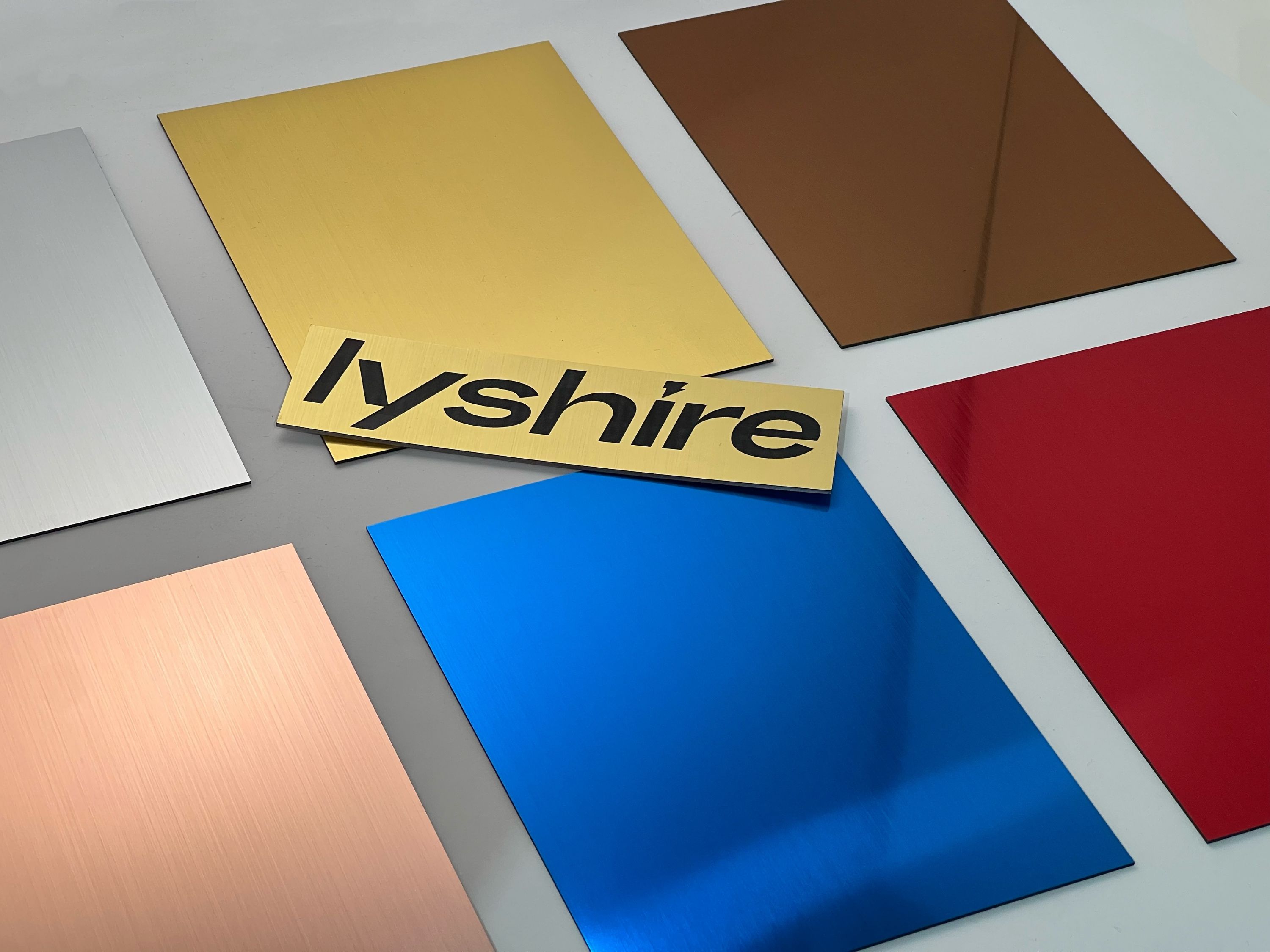
Most people assume thickness is what separates standard laminate from heavy-duty laminate, but that's only part of the story. The real distinction comes down to the wear layer's composition and the core's density. Standard laminate often has a wear layer measured in AC ratings of 3 or 4, fine for bedrooms or low-traffic hallways. Heavy-duty laminate pushes into AC5 or even AC6, using aluminum oxide treatments that resist scratches, scuffs, and moisture far longer. This isn't just marketing jargon—the top sheet on a heavy-duty plank can withstand daily abuse from rolling chairs, pet claws, and dropped tools without showing the same clouding or edge chipping you'll see on standard boards after a few years.
Underneath the decorative layer, the core tells another part of the difference. Standard laminate typically uses a high-density fiberboard (HDF) core that's adequate but can swell if water sits too long. Heavy-duty versions often swap in a denser, more moisture-resistant core or add a tighter locking system that prevents seams from lifting. In a kitchen or mudroom, where spills and tracked-in grit are constant, that difference shows up as floors that stay flat and quiet instead of developing hollow spots or raised joints. You'll also notice the locking profile on heavy-duty laminate tends to be thicker and milled with tighter tolerances, which makes installation less forgiving but the final result far sturdier.
Price is the obvious trade-off, but the real question is whether your space actually needs that extra resilience. Standard laminate works well in guest rooms or formal living areas where foot traffic is light and shoes come off at the door. Heavy-duty laminate earns its cost in entryways, home offices, or rental properties where the floor takes a beating daily. Instead of paying for a label, check the AC rating and core specs—those two figures tell you more about real-world performance than any thickness measurement or warranty length.
A Walk Through Our Bulk Panel Production Line
You might expect a production line to feel repetitive, but ours has a rhythm all its own. The first thing that hits you is the sheer scale: steel sheets stacked taller than a person, waiting to be fed into machines that hum at a frequency you feel in your chest. Workers move with a quiet familiarity, adjusting rollers and checking alignment without breaking stride. What stands out most is how each panel takes shape slowly at first, then all at once, as the press stamps the profile in a single decisive motion.
Walk a little further and the line reveals its quirks. Conveyor belts carry half-finished panels through a tunnel of blue light, where sensors measure thickness down to a fraction of a millimeter. There’s a slight smell of hot metal and machine oil that never quite leaves your clothes. One operator told me she can tell by the sound alone if a panel is off-spec, and sure enough, a dull thud sends her reaching for the override button before the computer even flags it. That kind of instinct can’t be automated.
By the time the finished panels reach the stacking area, they’re still warm to the touch. Someone runs a gloved hand along the edge, checking for burrs the way you’d check a freshly painted wall. Then the crane lifts a bundle and swings it toward the loading bay, and the line resets, ready for the next sheet. It’s not flashy work, but there’s a pride in watching raw steel become something you could build a warehouse from.
Custom Panel Design That Ships on Schedule
When you submit a panel spec, our engineering team doesn't just slot it into a generic template. We map out every cutout, connector, and labeling requirement against your actual application, then lock the design file for a quick prototype review. That clarity from day one is what keeps the schedule realistic.
Material lead times are usually where custom panel projects slip. We maintain a shortlist of pre-approved sheet metals, overlays, and components that we can source within tight windows. If a specific finish or membrane switch would push your date, we flag it early and offer alternatives that don't sacrifice function.
The production handoff includes a build sheet with labeled photos and a checklist for each panel. Once assembly is done, panels go through a full continuity and visual check before packing. Because the schedule was built around confirmed parts and tested steps, the ship date isn't a guess—it's a commitment.
What Makes Engraved Laminate Panels Last in Busy Spaces
Engraved laminate panels hold up in high-traffic areas because the surface layer is fused under extreme pressure and heat, creating a dense barrier that resists scratches, impacts, and daily wear. Unlike painted or printed finishes that can rub off over time, the engraving cuts directly into the laminate's core, so the design stays intact even when carts bump against it or hundreds of hands brush past each day.
The real secret lies in the resin-impregnated kraft paper beneath the decorative layer. This substrate doesn't warp or swell when exposed to humidity, cleaning chemicals, or sudden temperature shifts—common challenges in lobbies, corridors, and retail spaces. Since the panels are non-porous, they also resist staining and bacteria buildup, which means less frequent replacement and lower maintenance costs over the panel's lifespan.
Installation details matter more than most people realize. When panels are mounted with proper spacing and secured to a stable backing, they avoid stress fractures that can develop from building movement. Paired with UV-stable resins that prevent fading near windows or under intense artificial lighting, these engraved surfaces continue to look sharp years after installation, even in spaces that never slow down.
Bulk Pricing Without Losing the Hand-Finished Look
Scaling up order volume rarely pairs well with the kind of detail that makes a piece feel personal. The usual trade-off: lower per-unit costs mean stamped-out repetition, not the subtle variations that signal human hands. We took a different route. By rethinking how our finishing steps are sequenced—sanding, edge burnishing, hand-rubbed oil—we found ways to preserve those small, imperfect gestures even when production runs into the hundreds. The result is a bulk rate that doesn't flatten the texture or the warmth.
The trick lies in where we automate and where we don't. Cutting and initial shaping happen on precise machinery, which keeps waste down and consistency up. But the final pass—the part you actually touch—stays manual. Our finishers work in small batches, rotating through each piece rather than line-processing. That shift alone lets us offer tiered pricing for larger orders while the edges still soften differently under each thumb, the grain still catches light in its own way. It's not identical, and that's intentional.
For buyers, this means you're not choosing between a budget that works and a product that feels crafted. You get both, without the uncanny sameness that usually comes with volume discounts. We've had shops order fifty units and customers assume they were made one at a time. That's the benchmark—bulk pricing that leaves no trace on the finished look.
FAQ
We mainly work with high-pressure laminate sheets in various thicknesses. If you need something specific like fire-rated or anti-bacterial grades, those can be arranged too.
Yes, we often produce sample panels so you can check the engraving depth, edge quality, and color contrast before the full order goes ahead.
The laminate core itself is weather-resistant, but for outdoor installations we recommend adding a UV-stable clear coat over the engraved area to prevent fading and moisture ingress.
Vector files are best, such as AI, EPS, PDF, or SVG. If you only have a high-resolution raster image, we can usually convert it, though very detailed photographic work may need some adjustments.
It depends on the panel size and complexity. For standard sizes, we typically start around 50 panels, but we can sometimes accommodate smaller runs for new clients.
We use CNC-controlled engraving with calibrated vacuum tables, and every panel passes a depth check at several points. This keeps variation under 0.1 mm on standard materials.
You can choose panel dimensions, edge profiles, backing material, and finish. We also offer color filling in the engraved grooves, such as paint or resin, to make the design stand out.
Once artwork is approved and material is in stock, most orders ship within 2-3 weeks. If we need to source special laminate or hardware, lead time may extend to 4-5 weeks.
Conclusion
When you order engraved laminate panels in bulk, you need a factory that treats every sheet like it’s the only one on the line. We keep engraving sharp on large orders by running precision tooling checks between batches and using depth-calibrated bits that don’t wander, even after thousands of linear feet. The real difference comes down to substrate: standard laminate works for low-traffic walls, but heavy-duty laminate with a thicker core and higher-pressure overlay is what holds crisp lettering and fine detail in busy lobbies, schools, and retail spaces. Walking through our bulk panel production line, you’ll see why we can cut, engrave, and edge-band hundreds of panels in a single shift without sacrificing consistency—each sheet is registered against the same reference corner, and engraving files are nested to minimize waste while keeping grain direction uniform.
Custom panel design doesn’t have to mean missed deadlines. We run a dedicated scheduling lane for bulk orders, so your artwork, logos, and room numbers ship on the date you actually need them, not a best-case estimate. What makes engraved laminate panels last in busy spaces is the combination of UV-stable inks, sealed engraving grooves, and a factory-applied edge treatment that resists chips and moisture. And because we buy core material by the truckload and run hand-finishing in parallel with CNC work, bulk pricing doesn’t strip away the hand-finished look—you still get that subtle bevel, that clean fill, that sanded edge that makes a panel feel custom rather than punched out. The result is a product that reads as bespoke but budgets like commodity.
Contact Us
Contact Person: Tina Hou
Email: [email protected]
Tel/WhatsApp: +86 17816238685
Website: https://www.lyshire.com