
Chinese Non Oriented Electrical Steel: Essential Material for Efficient Motors and Transformers
2026-09-13
If you've ever wondered what keeps modern motors and transformers running cooler, quieter, and more efficiently, the answer often lies in a material most people never see: non-oriented electrical steel. In China, a new generation of producers is raising the bar, and none more so than Jiangsu Baowu New Materials. Their approach to this essential steel isn't just about meeting specs—it's about redefining what efficiency means from the core outward. What follows is a closer look at why this unassuming material has become a make-or-break factor in electrification, and why the source matters now more than ever.
Grain Size: The Quiet Driver of Motor Core Performance
In motor laminations, grain size rarely gets the attention it deserves, yet it quietly shapes how easily magnetic domains reverse. Smaller grains create more grain boundaries, and each boundary acts as a pinning site that resists domain wall motion. The result is higher hysteresis loss and a slight bump in coercivity, which can eat into efficiency at high switching frequencies. Manufacturers sometimes accept this trade-off because finer grains also improve yield strength and make stamping less prone to cracking, but the magnetic penalty is real.
Larger grains, on the other hand, give domain walls longer uninterrupted paths. This reduces the energy needed to magnetize and demagnetize the core, lowering core loss and improving permeability. However, pushing grain growth too far can degrade mechanical robustness and make the steel more sensitive to cutting stress, which partially reintroduces the very losses you tried to eliminate. The sweet spot often depends on whether the motor prioritizes high-speed efficiency or rugged, high-torque operation.
Modern annealing cycles and controlled rolling techniques let metallurgists steer grain size within a narrow band. Slight adjustments in soaking temperature or cooling rate can shift the average grain diameter by tens of micrometers, enough to measurably alter motor performance. Rather than chasing a single "ideal" size, experienced core designers balance grain structure against thickness, alloy content, and the specific flux waveform the motor will see in service.
How Chinese Mills Push Silicon Content Without Losing Ductility
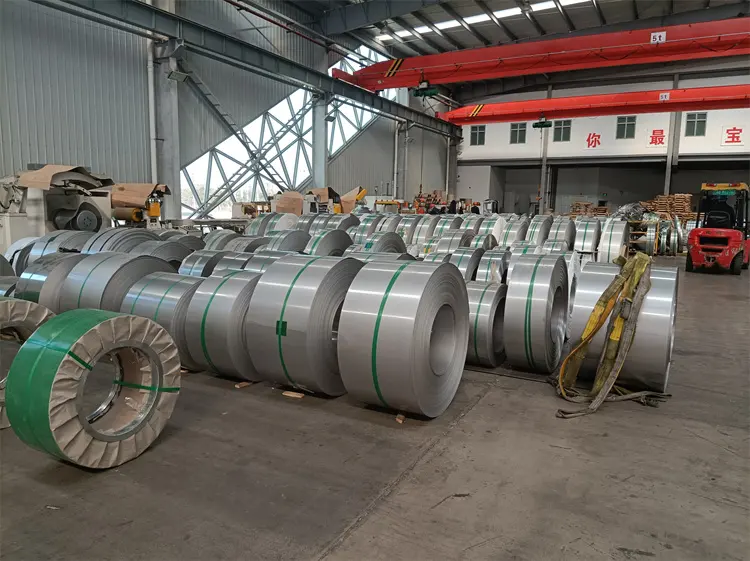
Chinese steelmakers have moved well past the old assumption that raising silicon inevitably embrittles the strip. Instead of relying on a single ladle addition, they now stage silicon into the melt across multiple tap points and pair it with tighter control over aluminum and nitrogen. This keeps inclusion populations small and evenly dispersed, so the grain boundaries stay clean even as silicon climbs toward 3.2–3.5 percent in electrical steels.
Hot rolling gets reworked as well. Mills hold finishing temperatures in a narrow band and run faster cooling on the runout table to limit coarse recrystallization before cold reduction. The result is a finer, more uniform grain after annealing, which preserves elongation values that older high-silicon grades could not match.
Downstream, continuous annealing lines use short soak times and aggressive overaging to relieve internal stress without allowing brittle ordered phases to develop. Some producers also add small amounts of tin or antimony to modify surface texture. The practical payoff is a strip that punches cleanly, stacks well in motor cores, and still meets ductility targets above 10 percent elongation.
The Thin-Gauge Gamble in High-Frequency Motor Laminations
At frequencies above 400 Hz, the appeal of thinner electrical steel is straightforward: core loss drops roughly with the square of lamination thickness, so switching from 0.35 mm to 0.20 mm can cut eddy-current heating by two-thirds. But pushing toward 0.10 mm or 0.05 mm turns into a real gamble. Material price climbs sharply, yield drops, and every subsequent handling step gets less forgiving.
Rolling silicon steel down to those gauges requires extra passes and tighter gauge control, which raises scrap rates before a single rotor or stator punch ever happens. Then the stamping process itself becomes a headache: thin sheets burr more easily, dies need more frequent sharpening, and stacked laminations don't always sit flat. On top of that, the insulation coating that prevents interlaminar shorts eats up a larger share of the stack height, so the actual magnetic cross-section shrinks even if nominal thickness goes down.
Mechanically, a stack of ultra-thin laminations is softer and more prone to vibration than a conventional core, so noise and structural resonance can appear where none existed before. Thermal conductivity through the stack often worsens because there are more interfaces. Still, for high-speed spindles, EV traction motors, and aerospace actuators, the gamble often pays off when the loss reduction outweighs the added cost and fragility. The skill lies in knowing when a few microns of steel are worth the trouble, and when they simply create a new set of problems.
Interlaminar Coatings: Where Transformer Losses Hide
Interlaminar coatings do not simply separate steel sheets; they alter the electrical path through the core. On grain-oriented silicon steel, the thin phosphate or organic film raises contact resistance between laminations enough to suppress eddy currents that would otherwise circulate across the stack. Without this layer, small imperfections like edge burrs or clamping pressure create conductive bridges, turning the core into a low-resistance path for stray currents.
Losses hide in places that standard core loss tests rarely isolate. After slitting or punching, the cut edges lose their coating and can smear metal across the surface. Stacking alignment and core clamping then press these exposed regions together. A single damaged lamination can produce localized hot spots that contribute disproportionately to total loss, yet remain invisible in aggregate measurements because they are averaged with the rest of the core.
Maintaining coating uniformity becomes more critical as core designs push toward thinner laminations and higher flux densities. A coating that is too thick increases stacking factor and reduces the active steel cross-section, while a coating that is too thin fails to provide reliable insulation. Manufacturers often trade off between these conflicting demands, and that is where marginal losses persist long after the design phase.
What a Non-Oriented Steel Datasheet Won't Tell You
Non-oriented steel datasheets give you a tidy table of magnetic flux density, core loss, and mechanical properties. What they leave out is how the material actually behaves once it hits your stamping line. The datasheet values come from standardized test coupons cut in one direction, but your motor laminations are punched, bent, and stacked under stress. Edge burrs, internal strain from shearing, and even the heat from a dull die can raise core loss by 15% or more compared to the lab number. If you rely only on the printed silicon content and nominal loss curve, you’ll be chasing inconsistencies that never show up in the spec sheet.
Another gap sits inside the coating. Datasheets mention insulation coatings, but they rarely describe how a C5 or C6 coating survives real production steps like annealing, varnishing, or interlocking. A coating that passes a Franklin test on a flat sample can crack at a tight corner radius or thin out under compressive stacking pressure. That leads to interlaminar shorts that quietly erode efficiency — and the datasheet won’t warn you. You also won’t find practical notes on how coating thickness affects weldability or how residual oil from stamping interacts with the insulation layer over thousands of thermal cycles.
Finally, the datasheet never talks about batch-to-batch drift. Two coils of the same grade from the same mill can differ in grain size, texture, and even surface roughness because of subtle variations in hot rolling temperature or cooling rate. Those differences change punchability, stack height, and final motor noise. A savvy engineer keeps incoming coil test data, not just the mill certificate, and adjusts press settings accordingly. The datasheet is a starting point — the real material speaks through your own process data, and that conversation never appears on the PDF.
Stamping, Punching, and the Real Cost of High-Silicon Grades
High-silicon grades don't just change magnetic behavior; they change the economics of the press shop. Every hit lands harder on tooling. Silicon above roughly 2.5% makes the strip noticeably less ductile, so punching and stamping edges chip dies faster and produce more burrs. Maintenance intervals shrink, and regrinds happen more often than with low-carbon or standard silicon steels. If your costing model assumes the same tool life as conventional grades, the real cost will quietly eat your margin.
The hidden line items aren't hidden to the operators. They see more frequent die changes, more edge cracking on complex geometries, and scrap rates that rise as the punches dull. On thinner laminations the problem sharpens: tighter clearances needed for clean cuts are harder to hold when the material fights back. Some shops compensate with slower stroke rates or extra finishing passes, both of which push unit cost upward.
Yet the premium can be worth it once the motor or transformer is running. High-silicon grades cut core losses, and that efficiency gain often outweighs a few extra cents per lamination. The trick is to feed the real stamping cost into the design decision early, not after the first tooling bill surprises the finance team.
FAQ
Non-oriented electrical steel has uniform magnetic properties in all directions, which suits rotating machines. Grain-oriented steel is optimized for a single rolling direction and typically appears in transformers. Chinese mills now supply both, but non-oriented is the workhorse for motors.
Large-scale investment, integrated supply chains, and steady quality improvements have helped Chinese mills offer competitive pricing and reliable volumes. They also benefit from domestic demand in appliance, automotive, and industrial motor sectors.
Lower core loss in watts per kilogram and higher permeability reduce energy wasted as heat. Thinner gauges, refined chemistry, and better insulation coatings all contribute. That directly cuts operating costs and supports higher efficiency classes.
Typical thicknesses range from 0.35 mm to 0.65 mm, with grades like 35W250, 50W470, or 65W800. Lower numbers after W indicate lower core loss. Mills also provide semi-processed and fully processed types depending on customer annealing capabilities.
Quality varies by mill, so buyers should verify ISO certifications, request third-party testing, and start with smaller trial orders. Reputable producers have closed gaps with international standards, especially for mid- and high-grade material.
Compressors, pumps, fans, power tools, EV traction motors, small transformers, ballasts, and home appliances all rely on non-oriented electrical steel. The EV transition is pushing demand for thinner, low-loss grades.
Producers are shifting toward premium grades with lower core loss, using improved steelmaking such as vacuum degassing and tighter rolling tolerances. Some also develop eco-friendly coatings and offer technical support for motor design optimization.
Check mill test certificates for magnetic properties, coating type, dimensional tolerances, and lamination factor. A reliable supplier will share long-term performance data and offer consistent surface quality, not just attractive pricing.
Conclusion
Chinese non-oriented electrical steel has quietly become the backbone of energy-efficient motors and transformers, yet its real-world performance hinges on details that rarely make the front page. Grain size, for instance, acts as an invisible throttle: finer, more uniform grains cut hysteresis loss but can raise punching wear, while coarser grains ease stamping at the expense of magnetic softness. Mills in China have learned to push silicon toward 3% and beyond without sacrificing ductility by refining hot-rolling schedules and annealing cycles—an art as much as a science. The trend toward thinner gauges, often 0.35 mm or 0.30 mm, pays off in high-frequency motor laminations where eddy currents multiply, but it is a gamble. Thinner strip magnifies any surface defect, and the steel's flatness becomes a make-or-break variable on automated lamination lines.
What often escapes notice is the interlaminar coating, a micron-scale film that can silently erase efficiency gains if its thickness, resistivity, or adhesion drifts. A datasheet may show impressive core loss numbers, but it will not tell you how that steel behaves after hundreds of stamping hits, or how burr height and die clearance alter the very grain structure at the cut edge. High-silicon grades, for all their magnetic appeal, carry a hidden toll: shorter tool life, more frequent die maintenance, and scrap that does not recycle as easily. Savvy motor and transformer makers therefore treat Chinese non-oriented electrical steel not as a commodity, but as a system—balancing silicon content, gauge, grain size, and coating against the realities of the shop floor. The result is a material that, when specified with eyes open, delivers the efficiency that tight energy standards demand without surprises in production.
Contact Us
Contact Person: Zoe Liang
Email: [email protected]
Tel/WhatsApp: 86 189 2128 6299
Website: https://www.baowuchina.com