
Cleanroom Turnkey Contractor Solutions for Precision Manufacturing Projects
2026-10-16
Precision manufacturing demands environments where a single stray particle can derail an entire production run. That's why choosing the right cleanroom turnkey contractor isn't just about construction—it's about engineering certainty. From modular panel systems to advanced HVAC and filtration, every detail must align with your process requirements and regulatory standards. At GENO Pharmatech, we don't just build cleanrooms; we design controlled ecosystems that keep your most sensitive operations running flawlessly from day one. In this article, we'll break down what truly makes a turnkey solution work—and how to avoid the hidden pitfalls that can compromise your project before it even begins.
Cleanroom Turnkey Projects Minus the Finger-Pointing
When a cleanroom build goes sideways, the usual reflex is to point at the architect, the HVAC contractor, the panel supplier, or the validation team. A turnkey approach removes that reflex by putting the entire sequence under one roof. From first sketch to final certification, the same team owns the schedule, the documentation, and the mistakes. That means no lost emails between subcontractors, no “that was never in our scope” calls, and no surprise invoices for work someone forgot to quote.
The real value shows up in the details that often fall through the cracks: door swings that match gowning flow, penetrations sealed before the wall panels go up, FFU placement aligned with the actual process layout instead of a generic grid. Because one group is accountable for the whole outcome, these decisions are made early and reviewed continuously. If something does need to change mid-project, there is a single point of contact with the authority to make the call, rather than a chain of subcontractors each protecting their own margin.
For cleanroom operators, this translates into fewer punch-list surprises and a handover package that actually reflects the built environment. Instead of chasing four vendors for as-built drawings and test reports, you receive one coherent set of documents. And when the room goes live, any residual issue has a clear owner, not a committee of finger-pointers.
Built for Precision, Not Just Particle Counts
Most particle sensors stop at a number on a screen. This one was engineered to earn that number. Every reading passes through a tightly controlled laser scattering path and a calibration routine that corrects for drift, temperature, and sensor aging. The result is repeatable data you can trust when deciding whether to ventilate, clean, or shut a process down.
Precision also means rejecting false alarms. Rather than inflating counts when humidity spikes or a nearby motor kicks up dust, the measurement engine weighs signal quality, coincidence loss, and particle shape before reporting. You see a stable baseline in a quiet room and a sharp, believable rise when something actually changes.
That matters in settings where a rough estimate isn't good enough—operating rooms, powder handling lines, or a bedroom for a child with asthma. The device keeps its calibration history and flags any drift instead of quietly drifting into guesswork. You're not just checking a box. You're seeing what's actually in the air.
Your Manufacturing Line Deserves a Cleanroom That Fits
A generic cleanroom rarely matches the way your line actually runs. Maybe your process needs a tighter ISO class only around the filling station, while the rest of the floor can breathe a little easier. Or perhaps your shift patterns mean half the room sits idle for hours, yet the airflow design still treats every corner as equally critical. When the room doesn't reflect the work, you end up paying for over-specification in one area and fighting contamination risks in another.
The right cleanroom bends to your line's rhythm. It accounts for how operators move, where materials enter and exit, and which machines generate the most particles. Instead of forcing your team to adapt to a box with fixed parameters, the room's layout, pressure cascades, and filtration zones are shaped around the actual production flow. This means less energy wasted on empty space, fewer bottlenecks at gowning or transfer points, and a validation package that matches what you really do, not what a standard template assumes.
Most importantly, a fitted cleanroom grows with you. Swap a piece of equipment, add a packaging step, or change your batch size, and the room can be reconfigured without tearing down walls or re-certifying from scratch. That flexibility keeps your line competitive and your compliance burden manageable, because the cleanroom is no longer a fixed constraint but a working part of your manufacturing strategy.
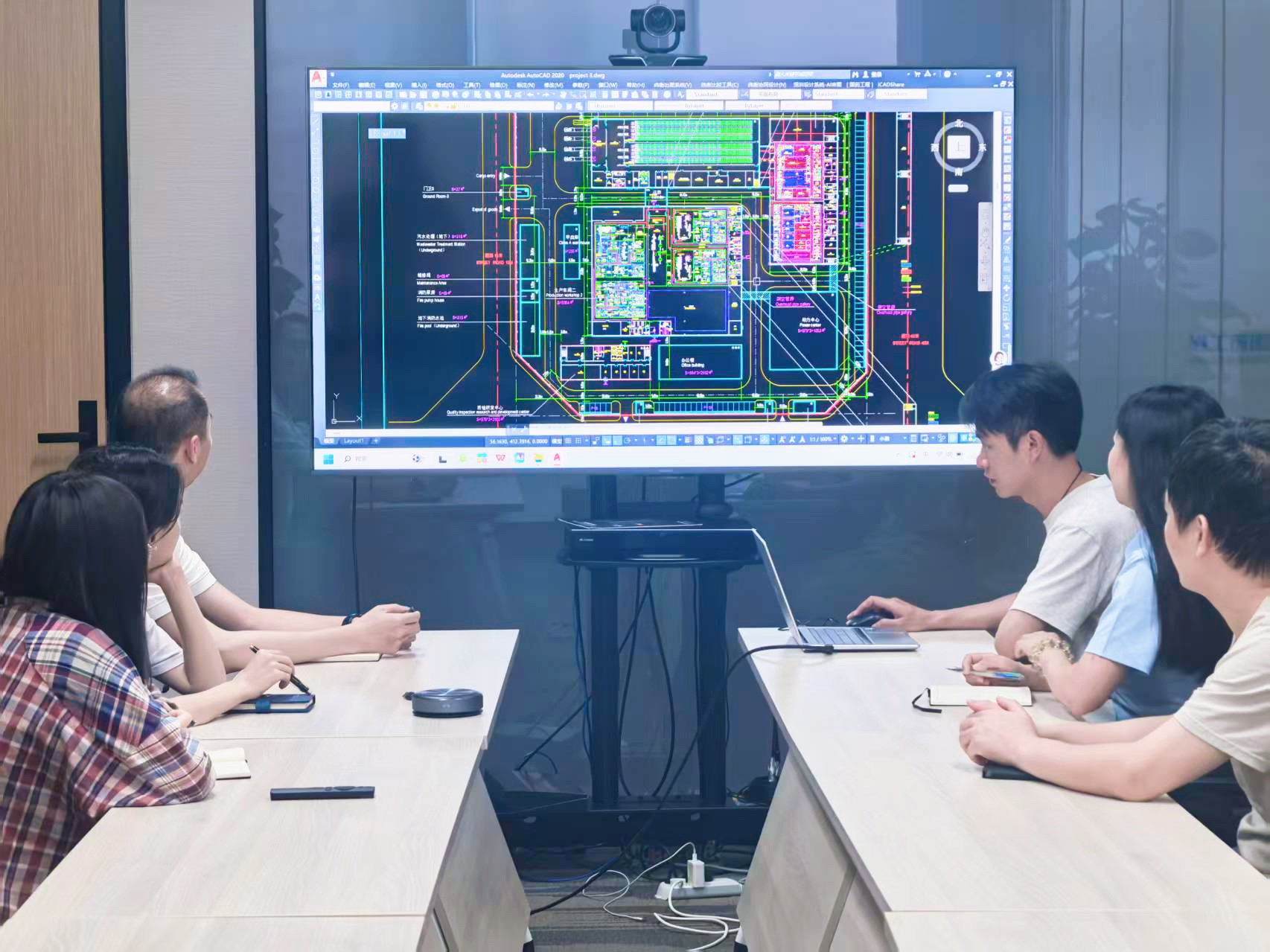
No More Coordination Chaos Between Design and Construction
The gap between what designers intend and what builders actually encounter has always been a quiet source of waste. A missed annotation here, an outdated sheet there, and suddenly a concrete pour has to be ripped out. When the same model drives both design decisions and construction sequencing, those surprises stop feeling inevitable.
On-site teams don't have to guess which drawing is current. They open the model, see the latest change highlighted, and flag conflicts while they're still cheap to fix — not after the crane is scheduled. Designers get feedback from the field without sifting through email chains or deciphering handwritten notes.
The payoff shows up in fewer formal queries, shorter closeout periods, and a project team that can actually talk about the building instead of arguing over versions.
Validated Performance from Day One, Not After Rework
Too many launches stall because core assumptions were never stress-tested until the final integration cycle. We take a different path: every critical subsystem gets validated against real usage loads and edge conditions from the first sprint, not as a late-stage cleanup. This shifts discovery of performance gaps from the panic window to the design phase, where fixes cost a fraction and don't ripple through already-frozen interfaces.
The result is not just fewer bugs at release, but a quieter rollout: no rushed patches, no weekend firefighting, no quiet compromises on throughput or latency. Teams that work this way stop measuring success by how quickly they can rework a broken build, and start measuring it by how little rework ever becomes necessary.
When a system runs correctly on day one, trust compounds. Customers don't see your validation logs, but they feel the absence of degradation during peak events. That's the real payoff of validating early and often: the performance you promised is the performance they actually get, without a hidden rework tax.
A Turnkey Partner Who Sweats the Micron-Level Details
Precision lives in places most partners never look. While others stop at “good enough,” our engineers chase the last micron because that’s where yield, reliability, and repeatability are won or lost. From laser alignment to thermal drift compensation, every adjustment is logged, verified, and re-verified against your spec—not just once, but across the full production window.
That obsessive focus on micron-level detail means fewer surprises at integration. Tooling interfaces are measured under load, not on a bench. Surface finishes are mapped, not eyeballed. And when a material behaves differently at 2 a.m. than at 2 p.m., our process controls already account for it—because we’ve seen it before. You get a partner who treats your tolerance stack as a personal challenge, not a checkbox.
The result isn’t just a part that fits. It’s a process that repeats, a supply chain that doesn’t stutter, and a partner who can explain exactly why your critical dimension stayed true—down to the last micron, every single run.
FAQ
From initial airflow modeling and architectural design to HVAC, filtration, flooring, and final certification, a single contractor takes responsibility for the entire controlled environment. For semiconductor or optical assembly lines, this includes managing temperature stability, pressure cascades, and particle counts before the space is handed over.
It usually comes down to expansion plans, cleanliness class, and site constraints. Modular systems can be deployed within weeks and rearranged later, which works well for ISO 7 or 8 areas. Processes needing ISO 5 or better often demand stick-built construction because the airflow uniformity and vibration control are harder to achieve with pre-fabricated panels.
Many teams underestimate the size and sequencing of material and personnel airlocks, focus only on particle counts while ignoring electrostatic discharge and vibration, or leave too little space around filter housings and equipment for maintenance. Those gaps often lead to contamination and costly downtime after startup.
Certain lithography, coating, and micro-assembly steps are extremely sensitive to moisture. Small shifts in relative humidity can cause material expansion, static buildup, or process drift even when the air is perfectly clean. That's why tight dew point control is often a higher priority than adding more fan filter units.
Yes, but it depends on the contractor's experience. Skilled teams phase the work using temporary containment and negative pressure enclosures, keeping adjacent areas live. They typically coordinate critical tie-ins during evening shifts or planned shutdown windows to minimize disruption.
A solid package contains airflow volume readings, HEPA filter integrity scans, pressure differential verification, temperature and humidity uniformity data, particle count reports, and auxiliary measurements like lighting and noise levels. All instruments used should have current calibration certificates.
The early layout should reserve removable wall sections, lift-out ceiling panels, extra structural load capacity, and oversized airlock doors. Simulating the movement path of anticipated equipment during design can prevent expensive modifications later.
High-efficiency EC fans, reduced airflow during non-production hours, demand-based adjustments for filtration, and low pressure drop filters can cut operating costs significantly while maintaining the required cleanliness level.
Conclusion
Precision manufacturing doesn't tolerate finger-pointing when a cleanroom falls short of spec. That's why a true turnkey contractor takes ownership of the entire lifecycle—from initial airflow modeling to final certification—so your team never gets caught between designers, builders, and validators. Instead of juggling multiple vendors with competing priorities, you get one accountable partner who sweats the micron-level details: ceiling grid alignment, door interlocks, pass-through sanitization, and even the static dissipation of epoxy flooring. The result is a facility that fits your actual production line, not a generic box with inflated particle counts on a datasheet.
For high-precision processes, a cleanroom must do more than meet ISO class limits. It needs to accommodate your specific tool layout, personnel flow, and material transfer without creating turbulence or dead zones. A turnkey partner coordinates design and construction under one roof, eliminating the chaos of RFIs and change orders that plague traditional projects. Validation happens throughout the build, not as an afterthought, so you avoid costly rework and delayed startup. From day one, the cleanroom performs as designed—temperature, humidity, pressurization, and particulate control all verified together. That's the difference between a contractor who puts up walls and one who delivers a working clean manufacturing environment.
Contact Us
Contact Person: Amy Yang
Email: [email protected]
Tel/WhatsApp: 008619330882686
Website: https://www.genopharmatech.com/