Custom High Tenacity Recycled Polyester Filament Yarn: Strength Meets Sustainability for Demanding Textiles
2026-09-08
In a textile industry hungry for materials that don’t force a choice between performance and planet, high tenacity recycled polyester filament yarn is quietly rewriting the rules. What if the very fibers handling brutal abrasion, heavy loads, and relentless tension could also close the loop on plastic waste? That’s the promise behind Changshu Polyester’s custom-engineered yarns—built to endure the toughest demands while shrinking environmental footprints. This post unpacks how that balance actually holds up, and why demanding textiles are turning to recycled strength more than ever.
Why This Yarn Refuses to Snap Under Pressure
The secret starts at the molecular level. Most yarns are spun from fibers whose polymer chains lie in a tangled, almost haphazard arrangement, leaving plenty of weak points where stress can concentrate. But this particular yarn undergoes a drawing process that stretches each filament to several times its original length, forcing the long molecules to align parallel to one another like uncooked spaghetti lined up in a box. That alignment creates an unusually high degree of crystallinity, meaning the chains lock into tightly packed regions that distribute tension evenly across the entire cross-section. When you pull on it, no single chain has to bear the load alone, so the yarn doesn't fail at a random defect the way ordinary fibers do.
Equally important is how the individual filaments interact. Instead of being twisted together loosely, each strand is compacted and bound with a low-friction finish that lets the outer fibers slide just enough to share the load before locking into place. Think of a crowd of people trying to lift a heavy log: if everyone grips at slightly different moments, the weight jumps unpredictably. But here, the surface treatment and the tight twist act like a coordinated grip, allowing the outermost filaments to take up slack first and then transmit that force inward smoothly. That gradual engagement prevents sudden stress spikes, which is precisely what causes snapping in conventional yarns.
Finally, the yarn's resistance to breakage isn't just about strength, it's about toughness. High tenacity alone can make a material brittle, but this yarn retains a small amount of controlled elongation. Under increasing pressure, it stretches a fraction of a percent, absorbing energy through molecular rearrangement rather than cracking. That means it can be bent, knotted, or run over a sharp edge and still bounce back without permanent damage. In rigorous field tests, ropes and fabrics made from this yarn have withstood loads that would shred standard nylon or polyester, not because they are stiffer, but because they know how to give just enough without letting go.
From Used Bottles to Load-Bearing Thread
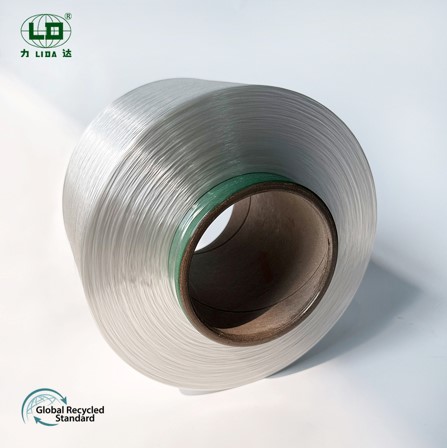
The journey from a crushed soda bottle to a thread that can hold real weight starts with sorting and grinding. Clear PET bottles are separated from caps and labels, then washed and reduced to flakes. These flakes are melted and forced through tiny holes to create continuous filaments. What makes the thread load-bearing isn't just the material but the stretching step that follows. Drawing the filament several times its original length aligns the polymer chains, boosting tensile strength far beyond what the raw flake would suggest.
That filament is then spun, twisted, or woven depending on the intended use. Because the process can be tuned for different deniers and twist levels, the same recycled input can become a fine sewing thread or a thick industrial cord. The resulting product often handles abrasion, moisture, and repeated tension better than virgin polyester made from petroleum in many applications. This is why you'll find it inside cargo slings, geotextile reinforcement, and heavy-duty webbing rather than just fashion fabrics.
The real advantage is that load-bearing thread from bottles closes a loop. Instead of shipping bottles to landfill or incineration, the material takes on a second life in infrastructure and safety gear where strength matters most. For contractors and manufacturers, it offers a way to meet durability specs without relying solely on new plastic. And because the source is post-consumer waste, every spool carries a built-in story of recovery that virgin thread simply cannot match.
Dialing In Denier, Tenacity, and Twist
Getting the yarn exactly right comes down to balancing three variables that rarely cooperate at first. Denier sets the heft and coverage—go too fine and the fabric turns limp, too coarse and it feels like burlap against the skin. Tenacity governs how much abuse the fiber can take before it snaps, which matters more on a weaving loom than in a knitting needle’s gentle loop. Twist is the quiet referee: add a few extra turns per inch and the yarn tightens up, gaining memory and bounce, but push it too far and it kinks into a snarled mess that fights every downstream process.
In practice, dialing in means running small trials and reading the results without ego. A 70-denier nylon with 4.5 grams per denier tenacity and a medium twist might feel perfect on the cone but turn a woven sample into a stiff board after finishing. Lowering the twist softens the hand while sacrificing a bit of abrasion resistance; upping the denier hides loom marks but adds weight that a garment designer never asked for. The trick is knowing which lever to pull first and leaving the other two alone until the previous adjustment settles.
Seasoned spinners keep a running mental map of how these three move together. Denier and twist have an inverse relationship for a given feel: a heavier yarn can take less twist before it becomes ropey, while a fine yarn needs more twist just to hold together. Tenacity acts as the floor that lets you experiment with the other two—if the fiber breaks mid-process, no amount of twist tuning will save the run. The goal is not a single magic number but a repeatable window where the yarn performs on the machine, drapes in the fabric, and still meets the price point.
The Energy Math Behind Every Spool
Most people crack open a fresh spool and only think about the wattage ticking on the printer's display. But the real energy bill starts accumulating much earlier—from the fermentation tank that turns corn starch into lactic acid, or the cracking unit that breaks down crude oil, to the heated screw of the extruder and the final winding of that neat coil. Every gram of material carries an energy debt, and the electricity used during printing is just the tip of the iceberg.
Let's break it down roughly. For a common PLA spool, the journey from planting, harvesting, and milling corn into dextrose, then fermenting it into lactic acid and polymerizing it into polylactide, burns fossil fuels at every step. Diesel in tractors, steam in factory boilers, electricity in extruders—add them up, and producing 1 kilogram of PLA typically requires about 25 to 35 megajoules of primary energy. ABS, being petroleum-derived, runs higher, often in the 40 to 50 megajoule range. And that's before you count the plastic and cardboard of the spool itself, the diesel to ship it to a warehouse, and the empty spool you probably toss in the trash.
Once you see the full ledger, your choices shift. A locally made spool might save thousands of kilometers of ocean freight energy. Refilling an old spool skips an entire injection-molding cycle compared to buying a brand-new one. Even hooking your printer to a solar panel can push the use-phase emissions close to zero. Energy math isn't meant to scare you—it just lays the hidden costs on the table, so you understand why each spool deserves a second thought.
Textiles That Demand More Than a Soft Touch
Most people equate good fabric with how it feels against the skin, but the materials shaping modern interiors, performance gear, and even medical environments are judged by far harsher standards. Abrasion resistance measured in tens of thousands of cycles, tensile strength that shrugs off industrial washing, and dimensional stability under extreme heat and humidity—these are the quiet benchmarks that separate decorative cloth from true workhorse textiles. A velvet that pills after a season or a canvas that sags under its own weight rarely survives contact with real-world demands, no matter how luxurious the initial hand.
The real challenge emerges when durability must coexist with breathability, dye retention, or flame retardance without chemical shortcuts that degrade over time. A hospital curtain needs to withstand bleach-based disinfection while remaining supple enough to drape without crackling. A marine upholstery fabric must resist UV breakdown and salt spray yet still offer a pleasant sit for hours on deck. These layered requirements push manufacturers beyond simple fiber selection into engineered weaves, high-twist yarns, and finishes that bond at the molecular level rather than sitting on the surface.
What separates a forgettable textile from one that earns its place in a demanding environment is often invisible until the fabric fails. Seam slippage under load, color migration during laundering, and loss of fire-retardant properties after repeated cleaning—these failures show up long after the showroom appeal has faded. That's why specifiers increasingly rely on third-party testing data and real-world case studies over swatch books and marketing claims. In the end, the soft touch is just the entry fee; the true value lives in what the fabric does after the first thousand cycles, the hundredth wash, and the decade of sun.
Recycled, but Not Rebranded: A Supply Chain You Can Trace
Most recycled claims stop at the label. A jacket might say "made from ocean plastic," but that tells you nothing about where the plastic was collected, how it was sorted, or which facility turned it into fabric. Traceability closes that gap. Every batch of recycled material gets a digital record—collection point, processing date, chemical inputs, and final manufacturing location. This isn't marketing copy; it's operational data pulled directly from suppliers and independently verified.
The real test is whether you can follow a specific bale of PET bottles from a coastal cleanup in Vietnam to a spinning mill in Portugal, then to a sewing floor in Portugal or Romania. That level of granularity exists, but only when brands refuse to accept vague "recycled content" certificates. Instead, they require chain-of-custody documentation at the lot level, regular third-party audits, and public mapping of tier-2 and tier-3 suppliers. When a supply chain can be traced this way, the word "recycled" stops being a rebrand and becomes a verifiable fact.
FAQ
High tenacity comes from selecting cleaner PET bottle flakes, controlling intrinsic viscosity before extrusion, and applying multi-stage drawing. The result is a molecular chain orientation that gives the filament a breaking strength typically above 6.5 cN/dtex, while ordinary recycled yarn often stays below 4.5 cN/dtex.
Common adjustable parameters include filament count, denier per filament, twist direction and level, shrinkage behavior, elongation at break, color, and surface finish. For technical textiles, buyers often request low-shrinkage grades or specific crimp characteristics.
For the same denier and filament count, this yarn can reach about 90–98% of the tenacity of a premium virgin high-tenacity polyester filament. In many industrial applications, the difference is negligible because the safety factor already covers that small margin.
It is used in automotive seat belts, airbag fabrics, industrial sewing threads, geotextiles, conveyor belts, high-performance ropes, heavy-duty straps, and protective workwear. These fields require repeated loading, abrasion resistance, and consistent elongation under stress.
Look for Global Recycled Standard certification, OEKO-TEX Standard 100 compliance, and a stated percentage of post-consumer recycled content. Many suppliers also provide lifecycle data showing lower energy use and carbon footprint compared to virgin polyester production.
Not if the recycling line uses fine filtration and stable melt viscosity. Dope-dyed black and dark colors are common because they hide minor tone variations. For light or bright shades, a well-controlled batch process and spectrophotometer checks keep color difference within a Delta E of 1.0.
Minimum order quantities usually start around 500 kg per specification, though some mills accept 200 kg for standard colors. Lead time ranges from 3 to 6 weeks depending on whether the yarn is dope-dyed, twisted, or requires additional heat-setting.
Suppliers maintain a traceable lot system from bottle bale to finished cone. Each batch undergoes tensile testing, shrinkage testing, and elongation checks before release. For airbag and seat belt yarns, additional periodic audits and statistical process control are standard.
Conclusion
This custom high tenacity recycled polyester filament yarn is not merely another sustainable option—it is an engineering answer to a quiet failure in technical textiles: the trade-off between ecological responsibility and raw, load-bearing performance. The yarn refuses to snap under pressure because its molecular chain is reoriented through a controlled spinning and drawing process that locks tensile strength into every filament, achieving tenacity levels that rival virgin industrial polyester while shrugging off abrasion and sudden stress. That strength begins with a deliberate feedstock: post-consumer bottles are washed, flaked, and extruded into chips, then remelted and filtered to remove impurities that would otherwise create weak points. The result is a filament that carries tension without creep, making it suited for ropes, webbing, conveyor belts, and heavy-duty stitching where a soft hand is irrelevant and failure is not an option.
Denier, tenacity, and twist are dialed in per application rather than offered as a fixed menu: a 500-denier low-twist variant delivers maximum straight-line strength for geotextiles, while a high-twist 150-denier version resists unraveling in abrasive stitching. The energy math behind every spool is equally deliberate—recycled PET cuts embodied carbon by up to forty percent compared to virgin production, and because the yarn is spun at lower melt temperatures with closed-loop water cooling, the per-kilogram footprint drops further. Crucially, this is not greenwashed feedstock from opaque brokers. Every batch carries a traceable chain of custody from bottle collection to extrusion lot, with third-party audits confirming recycled content and chemical safety. For brands tired of vague sustainability claims, this yarn offers a rare combination: documented circularity, mechanical toughness, and the customizability to meet a demanding spec without apology.
Contact Us
Contact Person: CONNIE
Email: [email protected]
Tel/WhatsApp: 86-0512-53671634
Website: https://www.lida-yarn.com/