Flexible Stone Factory: Revolutionizing Surface Design with Natural Stone
2026-07-31
Imagine natural stone that bends like leather, yet holds the timeless beauty of quarried rock. Magic Stone has shattered every rule in surface design, turning rigid slabs into flexible canvases for walls, furniture, and curves you never thought possible. At our factory, this isn’t just a product—it’s a quiet revolution rewriting what stone can do. Ready to see how we’re making the impossible routine?
How Natural Stone Became Flexible Enough to Wrap Surfaces
Stone is rarely associated with flexibility. Yet a curious intersection of material science and manufacturing ingenuity has quietly transformed rigid slabs into supple veneers that can drape over curves, wrap around columns, and cling to irregular contours. The secret lies not in altering the stone’s fundamental nature, but in re-engineering its structure at a scale barely visible to the eye. By shaving natural stone into ultrathin layers—sometimes as fine as half a millimeter—and bonding them to flexible backings like fiberglass, polymers, or even textile meshes, manufacturers create composite sheets that retain authentic surface grain while gaining the pliability of fabric. This marriage of ancient material and modern composite technology opens up design possibilities that once demanded artificial imitations.
The process starts with selecting stone that naturally splits along its micro-fissures, such as slate, mica-rich quartzite, or laminated sandstone. Once quarried, blocks are subjected to precise cutting techniques that peel off veneers rather than saw through them, preserving the stone’s integrity. These whisper-thin layers, often fragile on their own, are then stabilized by laminating them to a flexible substrate under controlled pressure and heat. The result is a material that can be rolled for shipping, bent around tight radii on-site, and even applied like wallpaper without cracking. What makes this evolution remarkable is that it bypasses synthetic replicas entirely—designers no longer need to settle for printed porcelain or resin-based panels when they want the depth and thermal character of true stone on a twisting wall or an arched ceiling.
Practical challenges, from transportation to installation, have been rethought along the way. Traditional stone slabs demand heavy handling equipment and risk fracturing during transit; flexible stone, by contrast, arrives in lightweight rolls that can be unboxed in an elevator and trimmed with a utility knife. Adhesion methods have also evolved: standard tile mortars often fail on dynamic surfaces, so proprietary bonding systems now allow stone to flex with the building’s natural movements without debonding. In interior applications like furniture cladding, curved reception desks, or sculptural feature walls, the effect is a seamless flow of natural texture that appears almost liquid. This quiet revolution hasn’t made stone any less authentic—it has simply taught an old material new postures.
Thin as Paint, Strong as Rock: The Innovation Behind Flexible Stone
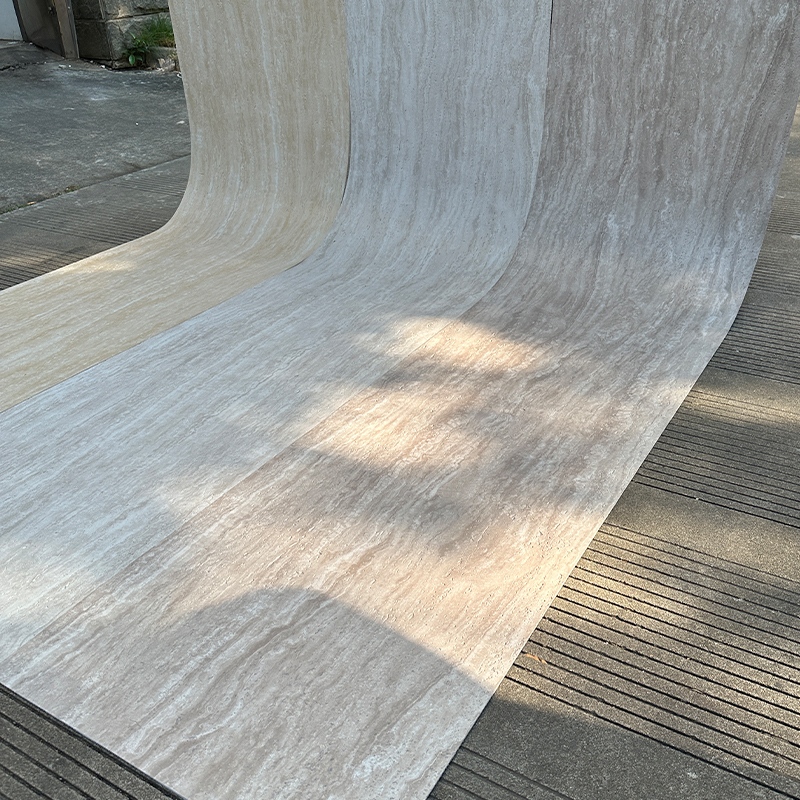
Flexible stone might sound like a contradiction, but this material redefines what we know about natural surfaces. It begins as a whisper-thin layer sliced from genuine stone, such as slate or mica, which is then bonded to a flexible backing. The result is a veneer that can bend, curve, and wrap around columns or curved walls, all while maintaining the authentic texture and durability of solid rock. It’s a clever marriage of geology and engineering.
The beauty lies in its ability to mimic the monumental without the weight. Traditional stone cladding demands heavy structural support and complex installation, but flexible stone can be applied like wallpaper, yet it resists impact as fiercely as a thicker slab. Its flexibility doesn't compromise strength; the material stands up to abrasion, moisture, and daily wear, making it suitable for high-traffic areas that would normally require rigid materials.
Designers now have a tool that lets them bring organic, textured finishes into spaces that were once off-limits. From rounded reception desks to undulating feature walls, the material opens up a range of creative possibilities. It’s thin enough to cut with scissors, yet tough enough to last for decades, quietly challenging the notion that strength must be thick and heavy.
Designing Without Limits: Curved Walls, Round Columns, and Beyond
When a space sheds its rigid corners, architecture begins to breathe. Curved walls carve out a sense of movement that flat planes rarely achieve, guiding the eye and body through a fluid journey. They soften a room’s acoustics and invite touch, making interiors feel more organic and less confined. Round columns do more than just hold up ceilings; they become sculptural focal points that anchor a design, merging strength with elegance. Used together, these elements push beyond conventional blueprints, creating environments that feel both timeless and daringly modern.
The beauty of working with non-rectilinear forms lies in the surprising spatial relationships they unlock. A gently arcing partition can define a zone without closing it off, preserving an airy openness while offering subtle privacy. Circular pillars break the monotony of straight pathways, encouraging a more meandering, intuitive circulation. Light plays differently here too—sweeping across curves, it casts softer shadows, enlivening every surface throughout the day. This approach demands an intimate understanding of materials and craft, but the result is a place that feels alive, almost responsive to the people who inhabit it.
Moving beyond the box opens up a world where design rules become prompts rather than restrictions. Whether it’s a sweeping freeform facade or an interior that defies angular logic, the absence of sharp edges communicates warmth and liberation. Such spaces adapt easily to unexpected functions—a round column might double as a display niche, a curved wall can transform into a cozy seating alcove. Instead of simply following trends, these designs tap into a deeper human connection, reminding us that our most memorable places are often the ones that break free from the predictable.
The Sustainable Side of Stone: Less Quarrying, More Coverage
Natural stone often gets a bad rap when it comes to sustainability, but the real story is more nuanced. The key lies in shifting our focus from relentless quarrying to maximizing the material we already have. By embracing thinner cuts and innovative fabrication techniques, we can stretch a single slab to cover far more surface area than older, chunkier methods ever allowed. This doesn’t just reduce the immediate demand for raw extraction—it also lowers the carbon footprint tied to transporting and processing each block. When we prioritize smart engineering over sheer volume, stone becomes a surprisingly resourceful choice.
The longevity of stone adds another layer to its sustainable profile. Unlike materials that need frequent replacement, a well-installed stone surface can last for generations, quietly storing carbon in its mineral structure all the while. Advancements like water-jet cutting and modular design let us use offcuts and remnants in creative ways, turning what was once waste into functional art. Combined with responsible sourcing practices—such as selecting quarries that rehabilitate ecosystems—the equation changes. It’s not about guilt-free consumption, but about making each extracted block count for much, much more.
Installation in Hours, Not Days: The Practical Perks
One of the most immediate and tangible benefits of our approach is the dramatic reduction in time from unboxing to full operation. Traditional setups can easily eat up days—or even weeks—of your team's focus, often requiring specialized technicians and a parade of calibration steps. We've stripped away those frictions. Out-of-the-box readiness means most configurations happen through intuitive software wizards, not thick manuals. You're not waiting on shipping delays for missing parts or deciphering arcane diagrams; everything is pre-assembled or clicks together with clear visual cues.
It’s not just about the raw speed, though. When installation takes hours instead of days, the real perk is how it preserves momentum. Imagine starting a Monday morning with a new unit arriving at the loading dock, and by that same afternoon your team is actively testing production workloads. That kind of turnaround transforms capital equipment from a logistical headache into an immediate force multiplier. The avoided downtime alone often offsets the entire hardware investment within the first few months, freeing your staff to focus on innovation rather than integration.
Beyond the immediate operational boost, there's a quieter advantage: the confidence that comes with plug-and-play simplicity. There’s no hidden complexity or cryptic error codes lurking behind a friendly setup screen. Because the process respects your existing workflow, you can roll out upgrades site by site without overhauling facilities or retraining entire departments. It’s about making the technology itself disappear, so you can get back to what matters—using it, not wrestling with it.
From Rustic to Modern: Aesthetic Versatility of Flexible Stone
Flexible stone slips effortlessly between design eras, its thin veneer carrying the raw, unpolished charm of a Tuscan farmhouse one moment and the crisp, minimalist lines of a city loft the next. In rustic settings, the material’s natural grain and earthy tones anchor spaces with a sense of history, as if the walls themselves have stories to tell. The surface, though thin, retains the deep texture of quarried rock, making it a favorite for exposed accent walls, fireplace surrounds, or ceiling treatments that crave warmth without the weight of traditional masonry.
When the aesthetic shifts toward modern simplicity, this same material transforms. Designers exploit its ability to wrap smoothly around curved partitions, illuminate softly from behind as a translucent feature, or lay in large, uninterrupted sheets that read almost like a matte paint. The muted palette—think soft shale grays, warm sand, and faint fossil imprints—complements cool concrete floors, steel beams, and open-plan layouts, proving that stone doesn’t have to be heavy-handed to make an impact.
What sets it apart is the ease with which it bridges extremes. A single room can blend reclaimed wood furniture with a sleek, contemporary fireplace clad in dark slate veneer, or a boutique hotel lobby might play a rough limestone texture against polished brass fittings. The flexibility isn’t just physical—it’s a design language that reads equally well in a cozy cottage or a high-rise penthouse, adapting its voice without ever losing the essence of stone.
FAQ
Flexible stone is made by extracting a thin layer of real natural stone and bonding it to a flexible backing, allowing it to bend and conform to curves that rigid stone panels can't handle. It retains the authentic texture and color of natural stone while being lightweight and easy to install.
Absolutely. It's weather-resistant and UV-stable, making it suitable for exterior facades, garden walls, and outdoor feature areas. Its flexibility also helps it withstand temperature fluctuations without cracking.
Installation is straightforward: apply a suitable adhesive to the prepared surface, press the sheet into place, and use a roller to ensure full contact. The sheets can be cut with simple utility knives or scissors, and they require no special tools or masonry skills.
We offer a wide range, including slate, quartzite, mica, and sandstone, each with distinct colors and textures. The selection covers everything from rustic earth tones to sleek contemporary finishes.
Yes, since it uses only a thin slice of stone from each block, it maximizes the yield of the raw material and reduces quarry waste. The production process consumes less energy compared to traditional stone cutting and transportation.
It adheres well to drywall, plywood, concrete, metal, and even existing tiles, as long as the surface is clean and primed. This makes it ideal for quick renovations without demolition.
No special maintenance is needed. It can be cleaned with mild soap and water, and occasional resealing will preserve its appearance for years. The natural stone surface is durable and stain-resistant.
Conclusion
Imagine natural stone so supple it drapes over curves, wraps pillars, and clings to surfaces like a second skin. At the heart of this transformation is a process that grinds genuine stone into a wafer-thin layer, bonded to a flexible backing, turning rigid rock into a pliable membrane. It's stone that bends without breaking, light enough to carry in rolls yet tough enough to withstand everyday wear. The innovation dismantles the age-old trade-off between the authentic beauty of natural slate, marble, or mica and the design freedom of man-made alternatives. Curved walls, rounded columns, and irregular contours that were once design nightmares become canvases, unlocking shapes once deemed impossible for masonry. This isn't just a product; it's a fundamental rethinking of what stone can do, born from advanced engineering in dedicated factories that treat stone like a textile.
Beyond aesthetic liberation, the flexible stone concept carries a quiet sustainability. By slicing stone into ultra-thin veneers, a single quarry block yields exponentially more coverage, dramatically reducing extraction impact. Installation shifts from laborious, multi-day masonry sagas to a swift, adhesive-based application completed in hours—no heavy equipment, no thick mortar beds. And the design vocabulary expands from rustic, earthy textures that mimic raw cliff faces to sleek, contemporary finishes that suit urban minimalism. Versatile, durable, and surprisingly practical, this factory-driven innovation redefines how natural stone is perceived and used, making it accessible for everything from feature walls in boutique hotels to DIY accent pieces at home. It’s stone, reimagined for the way we build and design today—fluid, fast, and responsibly sourced.
Contact Us
Contact Person: Vito
Email: [email protected]
Tel/WhatsApp: 86 13088879266
Website: https://www.magicstonemcm.com