
Freezer Glass Door Supplier Tips for Choosing Durable Commercial Refrigeration Glass
2026-11-16
Every freezer door tells a story about temperature swings, condensation, and late-night restocking. The difference between glass that lasts and glass that fails often comes down to choices made long before installation. From thermal shock resistance to edge coatings and spacer materials, there are quiet details that separate average units from doors that stay clear and reliable for years. Working with a supplier who understands those details—like ART—changes the conversation from replacement cycles to long-term performance. Here are the practical tips worth knowing before you specify your next commercial refrigeration glass.
What Actually Shortens Freezer Glass Life?
The fastest way to shorten freezer glass life is not usually a single hard knock. It is the small chip or hairline scratch along the edge that goes unnoticed. That edge is where the glass carries the most stress as it flexes with temperature changes, so even a tiny defect can turn into a long crack weeks after the original impact.
Rapid temperature swings do the rest of the damage. Setting a warm dish directly on a cold glass shelf forces the surface to expand unevenly, while the interior stays contracted. The same risk comes from rinsing icy glass with warm water during a quick defrost. The glass may survive a few times, but the strain accumulates in ways you cannot see until it fails.
Cleaning products play a quieter role. Sprays with ammonia or other harsh solvents can seep into the edge seal and break down the layer that keeps moisture out of the glass. Once humidity works its way inside, fogging and weakening follow. A mild cleaner and a dry wipe around the frame after cleaning tend to extend the glass life more than any aggressive scrubbing.
How to Read a Glass Door Before You Buy
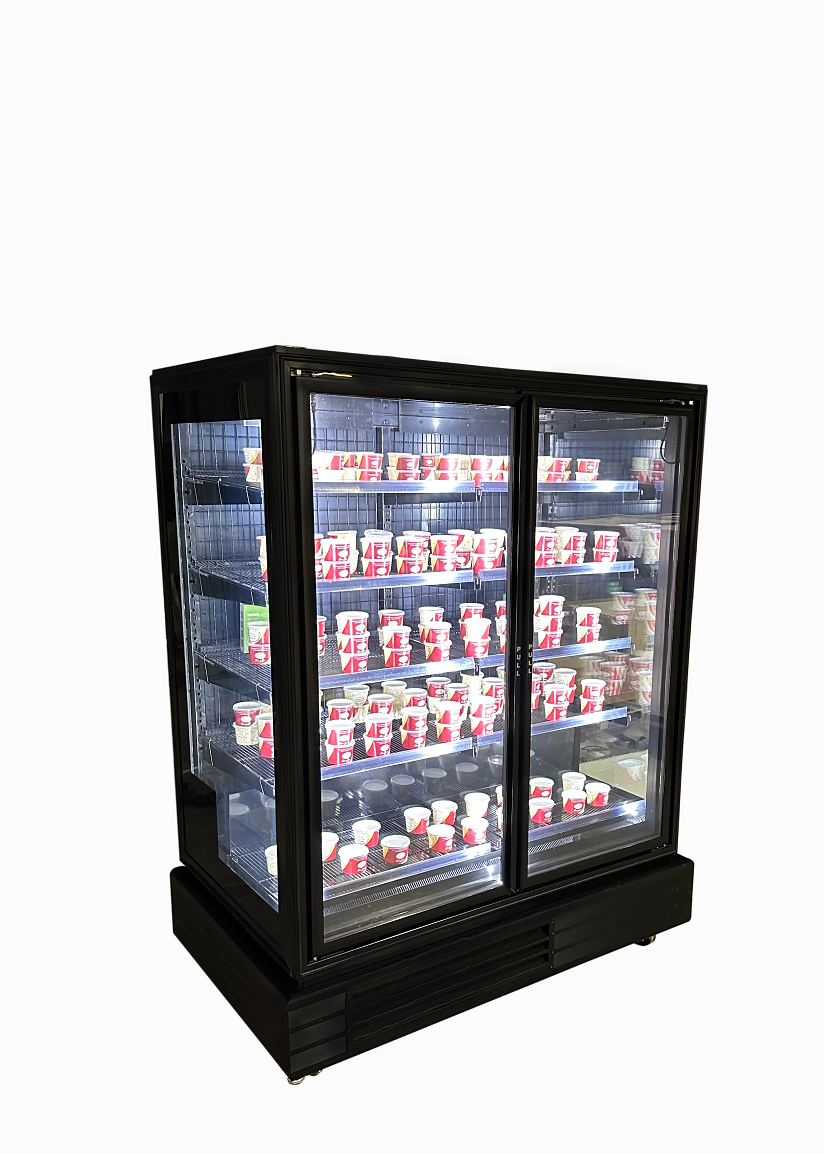
Start by checking the edges. A quality glass door will have smooth, polished edges with no rough chips or hairline cracks. Run your finger along the perimeter—if it catches, that's a sign of rushed manufacturing or hidden damage. Look at the corners too; sharp, unfinished corners often mean the door was cut from a larger sheet without proper finishing.
Next, ask about the glass type. Tempered glass breaks into small, dull pieces instead of sharp shards, making it the safer choice for entryways and patios. Laminated glass has a plastic interlayer that holds together when cracked. If the seller can't tell you which one you're looking at, move on. Also check for a permanent mark in one corner—most tempered panels carry a small etched logo or code.
Finally, hold the door up to natural light at a slight angle. Look for waves, bubbles, or distortion. A slight tint is normal, but visible ripples mean lower-grade float glass. If the door has a frame, inspect the joints where it meets the glass—gaps or uneven seals will let in drafts and moisture. A well-made door feels solid, not flimsy, when you lift it.
Why Some Low-E Coatings Fail Faster in Cold Storage
Low-E coatings inside cold storage rarely degrade from a single obvious cause. The bigger problem is the steady presence of condensation. When warm, humid air meets a cold pane, a thin film of moisture settles on the coated surface and lingers for hours. Most sputtered coatings are porous at a microscopic level, so that moisture works into the layer stack and slowly weakens the bond between the silver layer and its protective overcoat. The failure often starts as a faint haze near the edges before it spreads inward.
Repeated defrost cycles make the damage worse. The coating and the glass expand and contract at different rates, which creates shear stress at the interface. If the edge seal has even a small gap, water vapor gets pulled into the insulated glass unit during the cooling phase. Once inside, it condenses and freezes against the coating itself. That freeze-thaw repetition can lift the coating in tiny flakes, especially on south-facing or door-glazing panels that swing between cold storage temperatures and warmer loading dock air several times a day.
Cleaning chemicals also play an outsized role. Cold storage facilities often use alkaline detergents or quaternary ammonium sanitizers, and in a tightly closed room those residues stay airborne longer. A coating that handles normal window washing without issue may corrode quickly when the same cleaner is left as a fine mist on the glass at low temperature. Once the outer oxide barrier is etched, moisture reaches the silver layer directly, and the coating loses its reflectivity within a few months rather than years.
The Seal Details That Decide Whether Moisture Stays Out
Most people assume a tight-fitting lid or a thick gasket is enough to keep moisture out, but the real story lives in the seal geometry. The angle of the contact face, the compression set of the elastomer, and even the surface finish of the mating parts all influence whether water vapor sneaks in over time. A perfectly smooth flange can actually create more problems than a slightly textured one, because trapped air and micro-channels form more easily when there is no room for the seal material to flow. For outdoor enclosures, a single continuous bead often beats multiple overlapping seals; each extra interface adds a potential path for humid air, not just liquid water.
Then there is the matter of closure force. A seal that looks generous on paper can fail within weeks if the latch or screw spacing allows the cover to bow between fasteners. Uneven compression leaves low-pressure zones where even a hydrophobic material stops behaving as a barrier. The best designs pair a soft, high-recovery core with a firmer outer skin, allowing the seal to conform to surface irregularities while resisting permanent deformation. This combination handles temperature swings without opening microscopic gaps, which is exactly where condensation begins.
Finally, the details nobody sees matter just as much as the visible rubber ring. Drainage channels, pressure-equalization vents, and the direction of the seal lip all determine whether any moisture that does enter gets trapped or escapes harmlessly. A lip that faces outward sheds rain well but can pull water inward during thermal cycling. Flipping the lip inward keeps standing water away from the joint but demands better housing drainage. The winning approach is rarely a single trick; it is a coordinated set of small decisions around the seal that, together, decide whether the inside stays dry season after season.
Which Thickness and Tempering Choices Hold Up Long Term
Thickness rarely gets the attention it deserves until a countertop starts showing hairline cracks near the sink or a table edge chips after one hard knock. In daily use, 2cm slabs feel lighter and cost less upfront, but they often need plywood underlayment to survive heavy pots or an accidental elbow lean. 3cm material stands on its own with a more substantial look, and it handles edge profiles like ogee or bullnose without extra reinforcement. For high-traffic kitchens and bathroom vanities that see constant weight, 3cm tends to hold up better without hidden support failures.
Tempering is another variable people overlook until a hot pan leaves a ghost mark. Standard annealed glass or stone can be polished and repaired more easily, but it also scratches and chips with less provocation. Tempered surfaces resist thermal shock and flex better, making them a safer choice around cooktops or outdoor grills. The trade-off is that tempered material cannot be cut or modified after fabrication, so every sink cutout and faucet hole needs to be precise from the start. If you often place hot items directly on the surface, tempered is the smarter long-term bet.
For surfaces that will see a decade of meal prep, kids doing homework, and the occasional dropped mug, a 3cm tempered slab removes most of the usual failure points. It resists heat, absorbs impact without cracking, and keeps its edge profile intact. Where budget is tighter, a 2cm annealed option can still work in low-impact areas like a laundry folding counter or a hallway console. The real key is matching the thickness and tempering to how the surface actually gets used, rather than defaulting to whatever the fabricator keeps in stock.
Questions to Ask a Supplier Before You Commit
Before you sign anything or hand over a deposit, you need to dig into how a supplier actually handles problems. Ask for a specific example of a past order that went wrong—late materials, a misread spec, a shipping delay—and listen carefully to what they did about it. Vague answers like “we always communicate well” tell you nothing. You want to hear the concrete steps they took, who contacted the customer, and how long it took to put things right. A supplier who can describe a messy situation clearly and without blaming everyone else is worth far more than one who insists nothing has ever gone wrong.
Pricing conversations should go beyond the unit cost on a quote. Ask what changes would push the price higher after you commit: a different finish, a tighter deadline, a smaller batch than originally discussed, or shipping to a different address. Many disagreements start because the buyer assumed something was included while the supplier treated it as an extra. Also ask how they handle raw material price swings. If they say the price is locked no matter what, that can be a warning sign—either they are padding the quote heavily or they have not thought it through.
Finally, ask who exactly will be working on your order and how you can reach them if something feels off. In many companies, the person you negotiate with is not the person who schedules production or packs the boxes. If there is no direct line to someone on the floor or in the warehouse, small issues tend to grow silently for days. A simple question like “If I notice a problem at 9 a.m., who do I call and when will they get back to me?” can reveal more about the supplier’s real operating style than a polished capability statement ever will.
FAQ
Tempered glass is the baseline because it breaks into small blunt pieces instead of sharp shards. For most freezer doors, double-pane units with low-emissivity coating and argon fill do the heavy lifting against moisture and temperature swings. If the door will take carts, poles, or frequent cleaning, ask for a thicker outer lite, preferably 4 mm or more.
Fogging usually comes from a failed seal or a weak anti-sweat heating system. Reputable suppliers should provide a sealed double-pane assembly with moisture-absorbing desiccant inside the spacer and a warm-edge spacer design. Ask for documented dew-point testing. If the supplier can't talk about dew point or seal longevity, that's a warning sign.
Not exactly. Thickness helps with impact resistance, but you also have to consider weight on hinges and gaskets. A 4 mm tempered outer pane paired with a 3 mm inner pane is often a solid balance. Going much thicker can put extra stress on frame hardware and make doors harder to open and close comfortably.
Look at the edge work under good light. Polished, slightly rounded edges resist chipping better than raw cut edges. Also ask whether the glass is heat-soak tested. That process helps catch nickel sulfide inclusions that can cause spontaneous shattering later. A supplier that offers heat-soaked tempered glass is usually paying attention to long-term reliability.
Yes, a lot comes down to glass design rather than just heat. Double or triple glazing with low-e coating and argon or krypton fill keeps the outer surface closer to room temperature. Good frame insulation and a well-placed door gasket matter too. You still need some heat, but less if the glass unit is specified well.
Consistency. Ask for details on their inspection process, rejection rate, and whether they have in-house testing for insulation values and seal durability. Suppliers who can provide traceability by lot and have experience with commercial refrigeration brands tend to deliver fewer surprises on install day. References from other cold-chain facilities help too.
With good glass and proper installation, you shouldn't need frequent replacement. But schedule a visual check at least twice a year: look for fogging between panes, damaged gaskets, spots of rust on the frame, or doors that no longer self-close. Catching a small seal failure early can prevent the whole unit from turning into a frozen, clouded panel.
Conclusion
Freezer glass door life is rarely decided by a single dramatic failure; it is the accumulated effect of edge pressure, thermal cycling, and routine cleaning with the wrong products. Before you trust a supplier's claims, look at the glass itself. Tempered panels with consistent thickness and clean, unchipped edges tend to handle repeated temperature swings far better than thinner or unevenly cut alternatives. Low-E coatings also need careful evaluation because not all coatings are equal in cold storage. In humid or frequently opened environments, a coating that is applied under poor controls or paired with an incompatible spacer can develop haze, flaking, or dark streaks much earlier than expected. Ask how the coating is deposited and what testing it has passed under below-freezing conditions, not just for a generic performance number.
Moisture is the quiet killer of insulated glass. The edge seal, including spacer material, desiccant fill, and primary and secondary sealant coverage, decides whether fogging appears within a year or stays out for a decade. A slightly cheaper unit with a narrow seal or low-quality butyl often costs more later when condensation blocks the view and frost forms inside. When comparing suppliers, request sample doors or cutaway sections and examine seal width, spacer continuity, and glass flatness. Ask how they handle frame deflection, door gasket pressure, and long-term warranty claims in real cold storage settings. The right supplier should also explain which thickness and tempering combination suits the door size, traffic level, and temperature range instead of offering one standard panel. Durable commercial refrigeration glass is not found by trusting a data sheet alone; it comes from reading the construction details and asking pointed questions before you commit.
Contact Us
Contact Person: Ellen
Email: [email protected]
Tel/WhatsApp: +86-535-2229725
Website: https://www.artrefrigeration.com/