
OEM RCCB Selection Guide for Reliable Electrical Protection
2026-10-17
Most OEM buyers don’t realize that a generic RCCB can become the weakest link in their electrical design—until a nuisance trip halts production or a residual current goes undetected. That’s why this guide skips the theory and gets straight to what actually matters: rated residual currents, breaking capacity, environmental tolerance, and form-factor fit. If you're specifying protection for equipment that has to work every time, the decisions made at selection stage are irreversible. We’ll show you how to choose with confidence, drawing on field experience from ETEK’s OEM projects.
Voltage Ratings Beyond the Datasheet
Datasheets give you a nice, clean number—say 600V for an IGBT or 1200V for a SiC MOSFET. But real circuits don't live in the tidy world of a single line on a spec table. Voltage stress comes in spikes, ringing, and transients that can shove a device past its headline rating for microseconds or even nanoseconds. Understanding what happens beyond that printed number isn't just academic; it's the difference between a design that survives years in the field and one that fails on the first thunderstorm.
When you push a power semiconductor past its datasheet voltage, you're not simply crossing a hard cliff. Avalanche breakdown enters the picture—where the device starts conducting in a controlled but energy-dissipating way. Some devices, like older planar MOSFETs, can tolerate repeated avalanche events if the energy is low enough, while others, especially certain super-junction structures or SiC parts, can degrade quickly or fail catastrophically. The key is not to assume all overvoltage is equal. A 50V overshoot lasting 100ns might be harmless in one topology but lethal in another, depending on stray inductance, gate drive impedance, and the device's own avalanche energy rating—which, by the way, is often specified only in a footnoted graph, if at all.
A smarter approach is to design with the datasheet as a starting point, not a boundary. Measure the real voltage waveforms on your PCB, add margin for temperature variation and aging, and then decide whether you need a snubber, a higher-voltage part, or a different gate drive strategy. Sometimes the cheapest solution is simply to slow down the switching edge—but that trades away efficiency. Other times, a tiny RC clamp or a carefully placed ferrite bead can keep the voltage right at the edge of the rating without sacrificing performance. The engineers who get this right think in terms of voltage envelopes over time, not just a single max number. That's where robustness lives.
Matching RCCB Sensitivity to Real-World Leakage
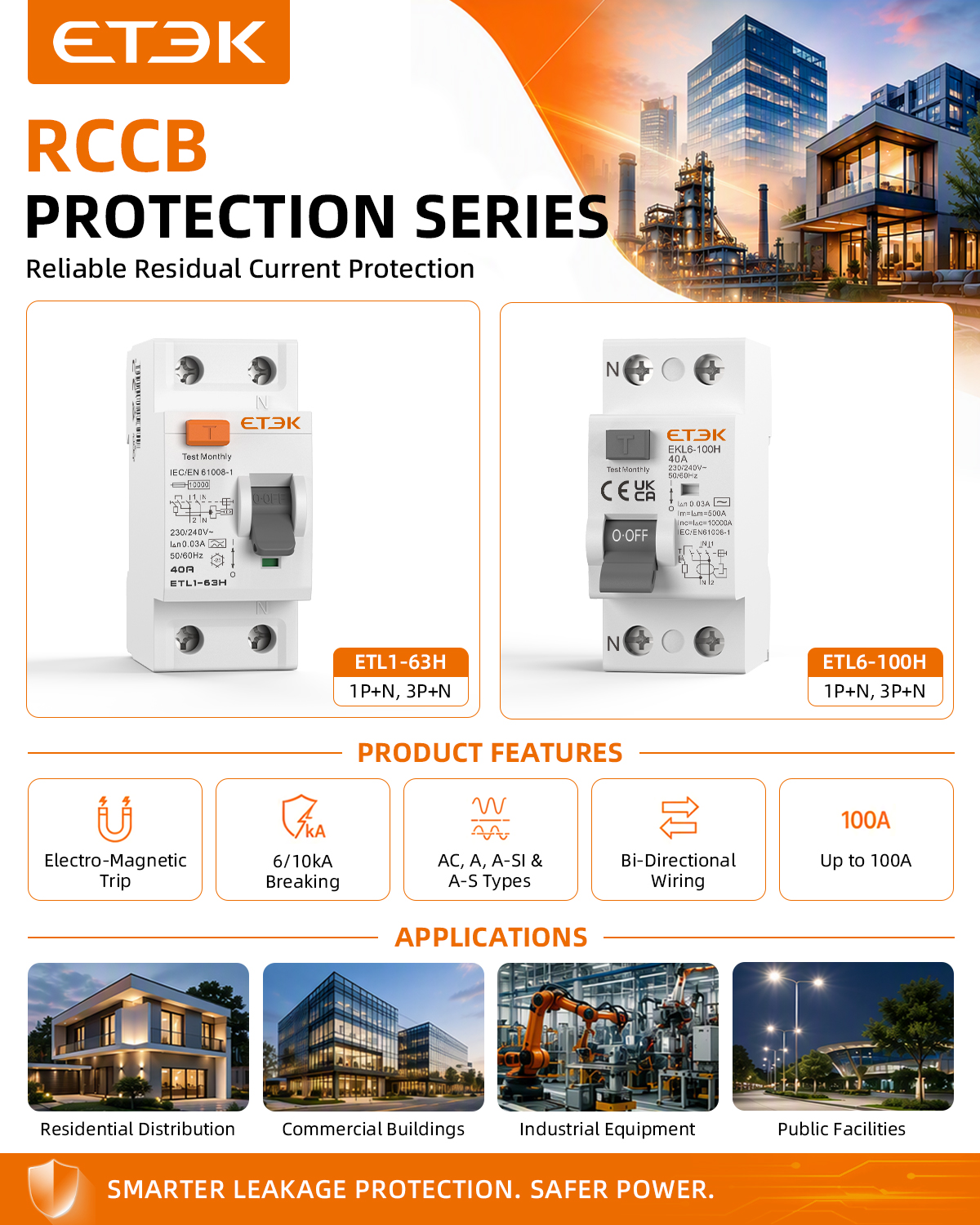
Field experience shows that choosing an RCCB purely by its rated residual operating current often misses the point. A 30 mA device may trip repeatedly on circuits with harmless background leakage from aging insulation, long cable runs, or multiple electronic loads, while a 100 mA unit can fail to protect against a partial earth fault that never reaches the threshold. The real task is to measure or estimate the standing leakage current under normal operating conditions, then select a sensitivity that sits comfortably above that baseline without sacrificing shock protection.
Matching sensitivity to real-world leakage means looking beyond the nominal trip rating. For example, a workshop circuit feeding several variable-speed drives might show 15–20 mA of continuous leakage; installing a 30 mA RCCB invites nuisance tripping every time humidity rises or a motor starts. In such cases, a time-delayed 30 mA device or a 100 mA unit with selective coordination may be more appropriate, provided supplementary protection is placed closer to the point of use. On the other hand, a single outdoor socket with a short cable run may have near-zero background leakage, so a 10 mA or 30 mA instantaneous trip device works reliably.
The goal is not to chase the lowest possible threshold but to find the highest sensitivity that will not trip under expected operating conditions. This requires knowing the circuit's insulation resistance, the nature of connected loads, and the cumulative leakage from parallel feeders. Once those values are known, the RCCB rating becomes a deliberate choice rather than a default setting, reducing both nuisance outages and undetected faults.
Why Ambient Temperature Is a Silent Killer
Heat rarely announces itself with the drama of a storm or a flood. A few degrees above or below what the body expects can quietly strain the cardiovascular system, disrupt sleep, and worsen existing conditions over days or weeks. Because the shift is gradual, people often adjust their clothing or thermostat without realizing their heart and kidneys are working harder to maintain a stable core temperature.
The real danger lives indoors, where temperatures drift outside comfortable ranges without obvious warning. Older adults, people with diabetes or heart disease, and those on certain medications may lose the ability to sense or respond to thermal stress. A living room that feels mildly warm to a healthy visitor can trigger dangerous dehydration or blood pressure shifts in someone whose thermoregulation is already compromised.
Death certificates rarely list 'ambient temperature' as a cause. Instead, spikes in heart attacks, strokes, and respiratory failures during heat waves or cold snaps get recorded as the underlying diseases. This invisibility keeps communities from treating indoor climate as a public health issue, leaving vulnerable people exposed to a threat that never looks urgent until it is too late.
Breaking Capacity: The Overlooked Safety Net
Most people sizing a circuit breaker look at the ampere rating and stop there. That number tells you how much current the device can carry continuously, but it says nothing about whether the breaker can actually open under a severe short circuit. If a bolted fault delivers 15,000 amps and the breaker is only rated to interrupt 6,000, the contacts may weld themselves together or the housing can rupture before the protection ever trips. That maximum interrupt rating—the breaking capacity—is the real safety net, and it gets ignored far too often.
Part of the problem is that normal operation hides the risk. A breaker with inadequate breaking capacity can work for years, cycling loads and clearing minor overloads without incident. The danger appears only during a rare high-energy fault, exactly the moment when the device absolutely must function. Installers sometimes assume any breaker that fits the panel and matches the load current is sufficient, but the prospective short-circuit current at the service entrance can be many times higher than what a standard residential or light commercial breaker is built to handle.
Checking breaking capacity means knowing the available fault current at the point of installation and selecting a device with an equal or greater interrupting rating, often expressed in kiloamperes like 10 kA, 22 kA, or 65 kA. Upgrades to transformers or utility feeds can raise that available current over time, quietly pushing older breakers past their limits. Treat the breaking capacity as a design requirement, not an afterthought. In a worst-case fault, it is the difference between a controlled disconnection and a violent failure.
Global Certification Traps for OEM Designs
When an OEM takes a product from a clean reference design into global markets, certification often becomes the silent schedule killer. The same hardware that sailed through FCC or CE testing can stumble on regional quirks like Japan's Radio Law requiring per-channel power calibration, or Brazil's Anatel demanding local lab testing even for modular approvals. Teams that treat certification as a final rubber stamp end up re-spinning antennas, swapping power supplies, or adding shielding late in the build, eating into margins and launch windows.
A subtler trap lies in how firmware features interact with spectrum rules. Dynamic frequency selection, adaptive power control, or even a debug mode left enabled can trigger a fail in one country while passing in another. Many OEMs discover too late that a Wi-Fi module certified in the EU with a specific antenna gain cannot be swapped for a higher-gain variant without retesting, and that some regulators require the OEM's own brand name on the certificate, not the module vendor's. Without locking a certification bill of materials early, the design can drift into a costly compliance maze.
The heaviest costs often come from trying to shoehorn a legacy design into new rules. For example, updating an existing product to add a new sensor or battery chemistry can invalidate prior safety approvals, forcing a full re-evaluation under IEC 62368-1 or equivalent local standards. Smart OEMs treat certification as a design input, not an output: they pin down target countries before schematic freeze, keep a living matrix of regulatory differences, and run pre-scans in parallel with firmware development. That way, the traps become checkboxes instead of fire drills.
Installation Habits That Undermine Protection
One of the most common installation habits that quietly weakens protection is treating every security prompt as an obstacle. Users often rush through setup wizards, disable real-time scanning, or postpone critical updates just to get back to work faster. That momentary convenience leaves the system in a half-configured state where the very features designed to block threats are no longer active.
Another damaging habit is layering multiple security tools without removing the old one. It feels like adding extra locks to a door, but two antivirus programs will often fight over the same files and system resources. The result is slower performance, missed detections, and a false sense of security because neither tool is running at full strength.
Finally, ignoring custom installation options undermines protection before the software even finishes loading. Bundled toolbars, pre-checked data-sharing boxes, or leaving default passwords unchanged can introduce backdoors or bloat that interferes with the core security functions. A few extra minutes spent reviewing settings during installation is often the difference between a hardened system and one that only looks protected.
FAQ
It walks through the key electrical and mechanical criteria for choosing residual current circuit breakers in OEM equipment, including rated current, sensitivity, breaking capacity, and environmental derating, so the protection matches the actual fault risks of the machine.
A setting that is too high may fail to trip on dangerous leakage currents, while too low can cause nuisance tripping during normal operation, which leads to unplanned downtime and field service calls.
Type AC only responds to sinusoidal AC leakage. Type A adds coverage for pulsed DC residual currents. Type B handles smooth DC residual currents. Equipment with rectifiers, switched-mode power supplies, or variable speed drives generally needs Type A or Type B.
The breaking capacity must exceed the available prospective short-circuit current at the point of installation. If it is too low, the device may fail to clear a fault safely or sustain damage during a short circuit.
Yes. Motor inrush and transient leakage currents can cause unwanted tripping. Select a residual current rating that allows for start-up peaks, or use a device with short-time delayed tripping, and verify compatibility with the motor starting characteristics.
Higher temperatures can reduce the continuous current carrying capacity and shift trip thresholds. The device should be selected or derated using the manufacturer's temperature curves to maintain dependable operation in sealed enclosures or hot industrial settings.
Use correct torque on terminals, keep protected circuits separate from unprotected wiring, avoid excessively long cable runs that raise background leakage, and confirm polarity and earthing before energizing.
It can, but you need to sum the expected leakage currents of all connected loads. If the total approaches the trip threshold, split the circuits across multiple RCCBs to reduce nuisance tripping and make fault tracing easier.
Conclusion
Selecting residual current circuit breakers for OEM applications demands looking past headline specs. Voltage ratings that work on a bench often collapse under real grid fluctuations, and a 30 mA device chosen from a datasheet may nuisance-trip when multiple drives or filters leak continuously. Field data shows ambient temperature derating is rarely applied correctly: a breaker rated at 40°C can lose meaningful sensitivity at 55°C inside a sealed enclosure, turning protection into a gamble. Equally critical is breaking capacity. Many OEMs treat the RCCB as a leakage-only device and forget that it must also interrupt a hard fault without welding its contacts—an oversight that surfaces only during a short-circuit event.
Certification adds another layer. A CE-marked unit is not automatically compliant with UL 1053 or IEC 61008 for every end market, and local inspector rejections often trace back to mismatched approvals. Installation habits compound these risks: coiled excess cable, shared neutral bars, or routing all phases through the toroid incorrectly can blind the sensor to actual leakage. A practical OEM guide should therefore pair electrical derating curves with mechanical installation drawings, and insist on tested combinations rather than mixing brands of breakers and toroids. Reliable protection is not a single component choice—it is the sum of voltage, temperature, fault current, certification, and wiring discipline.
Contact Us
Contact Person: Andy
Email: [email protected]
Tel/WhatsApp: +86 13356133008
Website: https://www.etek-china.com/