
Power Transmission Tension Tower Solutions for Reliable Grid Expansion Across China
2026-11-19
China’s grid expansion is pushing transmission lines into tougher terrain and higher load demands, where the tension tower often decides whether a corridor holds firm or becomes a recurring headache. Anbang brings a sharper focus to these structures—combining load-path precision with fabrication consistency so reliability is built in from the first bolt to the final crossarm.
What Tension Towers Really Need to Withstand in China’s Harshest Terrain
Unlike suspension towers that mainly carry vertical loads, tension towers have to hold conductors at dead-end, angle, or section points where longitudinal pull is concentrated. In the Hengduan Mountains of southwestern China, lines often run along knife-edge ridges with a huge difference in span length on either side. If a conductor snaps or ice suddenly drops, the unbalanced load can spike in a fraction of a second. The tower body, bolts, and anchor foundations all need to absorb that shock without being dragged off the slope.
Ground conditions often decide whether a tower survives long before the first windstorm hits. On the Qinghai-Tibet Plateau, the active layer above permafrost freezes and thaws every year, slowly jacking foundations upward or leaving them tilted. In the Gobi, a daily temperature swing of more than forty degrees can push steel toward fatigue while sand-loaded wind scours the lower legs. In the karst hills of Guizhou and Yunnan, cavities and fissures beneath a pad may stay hidden until heavy rain flushes out the fill, so grouting and deep anchoring are routine rather than optional.
Wind and ice rarely act alone, and their combined effect is what really tests a tension tower. In high-altitude heavy icing zones such as Liangshan and northeastern Yunnan, conductor ice sleeves can exceed thirty millimeters, and uneven shedding creates a violent snap load far beyond the static weight. Canyon gusts can exceed forty meters per second, while the tower must also avoid low-frequency galloping resonance with the conductors. Designers therefore stack multi-year return-period extremes with local terrain amplification factors, knowing that one missed detail can bring down an entire section.
Why Western China’s Grid Expansion Depends on More Than Tower Height
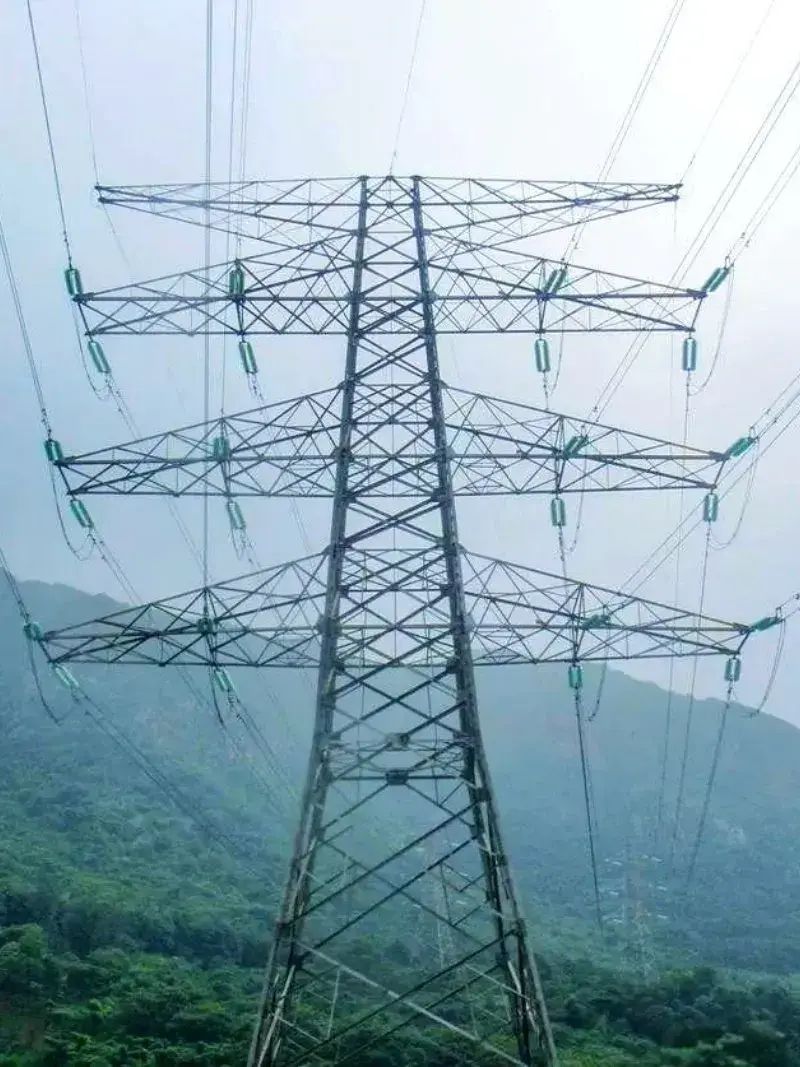
In much of western China the visible challenge looks vertical, as if taller towers could solve the region's transmission bottlenecks. But grid expansion here is shaped as much by what lies under the foundations as by the steel above them. Loose loess, permafrost, narrow river gorges, and access roads that disappear during the wet season regularly force route changes that no increase in tower height can fix.
High altitude also rewrites the engineering rules. Thin air lowers insulation strength and reduces cooling, so the same conductor that works in a coastal corridor may run hotter and need a wider safety margin on the plateau. Dust, ice, and intense ultraviolet exposure age equipment in ways that a taller structure cannot offset. Planners often spend more time on insulator creepage, foundation curing, and line ratings than on tower geometry itself.
The human and ecological constraints are just as important. Corridors cross grazing routes, protected wetlands, and landslide-prone slopes, where routing decisions have to account for consent, wildlife movement, and long-term access. A line that looks efficient on a map can stall for months over a single valley community or a seasonal nesting area. Expanding the grid in this terrain is less about building upward and more about designing around ground-level realities that a cross-section drawing never shows.
Bolted Joints, Galvanized Steel, and the Details That Keep Towers Standing
Most structural failures in lattice towers are not born in the primary legs or diagonals; they begin at the bolted interfaces where vibration, thermal movement, and wind reversals concentrate their work. A properly preloaded bolt acts like a clamp, keeping the connected plies from slipping and preventing the hole edges from chewing into the shank. Lose that clamping force through relaxation or poor installation, and the joint becomes a fatigue site instead of a load-transfer point.
Hot-dip galvanizing gives steel its sacrificial layer, but the protection is not uniform where it matters most: cut edges, punched holes, and thread roots often carry thinner zinc than the flat surfaces around them. Field assembly inevitably scrapes coating from bolt heads and nuts, and if those scars are left untreated, the exposed steel can corrode faster than if the tower had never been coated at all. Touch-up practices, torque checks, and the use of compatible hardware are what keep the galvanized shell from being just a temporary skin.
Small details—the direction of a washer, the presence of a locking device, the way a splice plate sheds water—decide whether a tower shrugs off decades of loading or develops the rust streaks and loose bolts that signal trouble. Inspectors who look for fretting dust, cracked coating around holes, and shifted members are reading the structure's maintenance history before those clues become structural findings.
How Foundation Choice Prevents Costly Failures on Unstable Ground
On unstable ground, the difference between a foundation that lasts and one that fails often comes down to choosing a system that moves with the soil rather than fighting it. Expansive clays, loose fill, and poorly drained silts each create different stress patterns, and a slab poured without accounting for those patterns can crack within the first wet-dry cycle. A raised pier foundation, by contrast, keeps the structure above the zone where moisture swings are most aggressive, while a properly engineered raft slab spreads differential movement across a wider area so no single corner takes the full brunt.
Costly failures rarely announce themselves as sudden collapses. They start as hairline cracks at door corners, sticking windows, or a porch pulling away from the main frame. Those symptoms often trace back to a foundation that was never matched to the soil's expansion potential or drainage behavior. Site-specific choices, such as deepening footings below the active zone, installing subsurface drains, or using void forms under grade beams, are not add-ons; they are the difference between routine maintenance and a six-figure underpinning job later.
Builders who treat foundation selection as a budget line item tend to pay for it twice. The first payment happens when the concrete is poured. The second happens when the ground reminds everyone that it was never as stable as the site plan assumed. Taking soil borings seriously, reading the plasticity index, and adjusting the foundation type before framing begins cost far less than trying to stabilize a structure after it has already started to move.
Faster Construction Without Cutting Corners on Long Transmission Spans
Long transmission spans often sit in rough terrain where every extra week of work drains budgets and patience. The usual temptation is to hurry the stringing and tensioning, but that's where costly mistakes hide. Instead, crews can pick up real speed by sequencing tower erection with conductor pulling so one crew never waits on another. Prefabricated spacers, pre-sagged travelers, and field-checked dead-end assemblies cut hours without lowering the safety margin.
A smarter approach treats the span as a series of small, repeatable moves rather than one long push. Ground-level rehearsal of critical lifts, clear hand signals, and pre-positioned tools at each structure remove idle time. When weather windows open, the crew is already staged and ready to pull. This kind of preparation feels slower on paper but finishes faster in the field because nobody is improvising under load.
The difference shows up in the final sag and vibration checks. When every connection is torqued to spec and every conductor layer is handled with clean rigging, the line settles into service without rework. Faster construction, in this sense, isn't about skipping steps. It's about removing the friction between them so the span goes up quickly and stays up reliably.
Where Maintenance Costs Hide on Remote High-Voltage Lines
On paper, a remote transmission line looks like a straightforward asset: towers, conductors, insulators. The real ledger starts bleeding where the pavement ends. Crews often lose half a shift just reaching a structure on washed-out access tracks, and every mile of bad road adds wear to trucks, trailers, and winches. Helicopter patrols and lifts get billed by the hour, but the hidden part is the waiting: fog in the valleys, high wind on ridges, or a four-day storm that turns a one-day insulator swap into a week of standby charges.
Vegetation and weather do more damage than the line itself, but the cost hides in the margins. A single overgrown access corridor can force a utility to choose between expensive matting, erosion repairs, and slower ground travel. Salt spray or industrial fallout eats hardware faster than the design tables suggest, so inspection cycles quietly shorten and replacement inventories grow. Even routine tree trimming becomes a logistics puzzle when crews have to pack fuel, water, and safety gear into places with no cell service and no easy turnaround.
Then there is the cost of knowing what is actually happening on the line. Remote monitoring equipment sounds efficient until it needs its own power, spare parts, and someone to reach a dead sensor in bad weather. Stocking spare dampers, insulators, and conductor sections at distant depots ties up capital that never appears on a maintenance chart. Storm response is the bluntest example: utilities preposition crews, fuel, and bedding in motels or camps, and every hour of waiting is a cost that only shows up when the lights stay on.
FAQ
A suspension tower mainly carries vertical loads, while a tension tower is built to hold longitudinal conductor pull. That makes it the anchor point at corners, dead-ends, and long section breaks, preventing a local failure from pulling down an entire string of towers.
They often use unequal leg extensions and compact crossarm arrangements so the same tower body can sit on steep slopes without large earthworks. The line can follow ridges and river valleys instead of forcing a straight route.
Hot-dip galvanizing is the baseline, but for salt spray and industrial fallout we specify heavier zinc coatings or weathering steel. In a few retrofit cases, a zinc-aluminum coating is applied to extend the interval between repainting.
Most designs follow the GB 50545 code for overhead lines and DL/T 5154 for tower structures, plus utility-specific rules from State Grid or China Southern Power Grid. Some UHV corridors also adopt stricter deflection and fatigue limits than the national minimum.
Often yes. The tower body can be reinforced with additional bracing or plate doublers, foundations can be enlarged, and insulator strings can be replaced to handle higher conductor tension. That allows a capacity increase while the line stays partly energized.
The towers are split into small bolted modules that can be carried by mule, cableway, or light helicopter. Since connections are bolted rather than welded on site, crews can erect a tower in a short window without bringing heavy equipment to the top.
Steel is traceable to the heat number, welds get ultrasonic or magnetic particle testing, and the whole tower is trial-assembled before shipment. After erection, torque checks on critical bolts and galvanizing thickness measurements are recorded for each structure.
They create controlled section points so if a conductor breaks or ice loads become uneven, the damage stops at the nearest tension structure instead of cascading for kilometers. It also simplifies stringing and future maintenance isolation.
Conclusion
Across China’s western corridors, tension towers sit in places where weather and ground conditions change sharply over a few kilometers. They carry ice-laden conductors in high-altitude passes, resist wind funnelled through valleys, and hold line angle forces on ridges where suspension towers would be pushed beyond safe limits. The real challenge is not simply building taller steel. Tower height helps with clearance, but long spans and rough terrain demand a tension structure that matches the load path from conductor to anchor bolt. In unstable loess, permafrost, or areas with seasonal ground movement, foundation choice often matters more than tower geometry. A well-chosen footing can prevent differential settlement and the slow misalignment that eventually turns into a broken crossarm or a downed line.
Reliable grid expansion therefore depends on details that are easy to overlook during fast construction. Galvanized coatings, correctly torqued bolted joints, and controlled sequencing let crews raise longer tension spans quickly without cutting corners on fatigue life. However, speed at the tower site is only part of the picture. On remote high-voltage lines, maintenance costs hide in access road repairs, corrosion inspections, spare-part storage, and the long trips crews make to reach a single structure. A practical tension tower solution combines terrain-specific design, disciplined assembly, and a foundation strategy that anticipates ground movement, keeping the line stable long after commissioning and reducing the need for repeated intervention in difficult terrain.
Contact Us
Contact Person: antor khan
Email: [email protected]
Tel/WhatsApp: 8613863903569
Website: https://www.qdabtower.com/