
Shock Absorber Jounce Bumper Exporter Delivers Durable Suspension Parts Worldwide
2026-11-16
Every pothole, speed bump, and rough dirt road tests a vehicle's suspension—and the jounce bumper sits right at the heart of that abuse. When it fails, the damage ripples through struts, mounts, and chassis. That's why global distributors are turning to XIAYI, a shock absorber jounce bumper exporter known for parts that shrug off punishment and keep fleets running. Here's what makes their suspension components a go-to choice from Mexico to Malaysia.
The Overlooked Suspension Component That Protects Shock Absorbers on Every Road
Most drivers never give it a second thought, yet this small rubber or foam piece sits quietly at the top or bottom of the shock absorber, taking the hit when the suspension runs out of travel. On potholed city streets or rough gravel roads, the spring compresses hard, and without this buffer the shock absorber's piston would slam into its own housing. That repeated metal-on-metal impact is exactly what kills shocks long before their time. The component is cheap, often overlooked during routine inspections, but it does the dirty work of absorbing the final, violent jolt that the spring and damper simply cannot handle alone.
When it wears out or crumbles away, the symptoms are easy to misread. You might notice a harsher ride over speed bumps, or a dull clunk when the suspension bottoms out. Inside the shock, the hydraulic seals take a beating every time the piston reaches the end of its stroke. Over weeks and months, oil leaks begin, damping fades, and the whole strut assembly needs replacement—far more expensive than the small part that could have prevented it. Some vehicles use progressive foam stops that also act as secondary springs, subtly improving handling during hard cornering or heavy braking. Lose that, and the car not only rides worse but also loses a bit of composure in emergency maneuvers.
Checking this protector takes only a minute. Jack up the car, pull the dust boot aside, and look for cracks, tears, or missing chunks. If the original piece has turned hard and brittle with age, it is no longer doing its job. Replacing it often requires removing the shock, but the cost is minimal compared to new dampers. For anyone who drives on rough roads, carries heavy loads, or simply wants their suspension to last, this forgotten piece of rubber is one of the smartest preventive fixes. It will not make the car faster or flashier, but it will keep the ride comfortable and the shock absorbers alive through every pothole and curb drop the road throws at them.
Inside the Global Supply Chain Moving Suspension Parts Across Continents
A shipment of control arms leaves a forging plant in southern India on a Tuesday, bound for an assembly line in Mexico. The parts travel by truck to Chennai port, then by container ship through the Suez Canal or around the Cape, depending on routing and risk assessments, before reaching Veracruz. Each handoff adds a layer of paperwork, customs checks, and the quiet possibility of delay.
Once the containers clear Mexican customs, they move by rail or flatbed to a tier-one supplier near Guanajuato. Here the suspension components are unboxed, inspected for surface corrosion or micro-cracks, and sequenced for just-in-time delivery to the automaker. Warehousing is limited, so timing has to be precise; a single missed truck can idle a line for hours.
Behind the visible movement is a less obvious flow of data. Freight forwarders, port operators, and logistics planners exchange booking confirmations, temperature logs, and exception alerts through cloud platforms. This digital layer lets teams reroute around strikes, weather, or congestion without losing sight of inventory levels. The result is a supply chain that feels seamless from the factory floor but is actually held together by constant negotiation and contingency planning.
What Makes a Jounce Bumper Outlast Standard Rubber Parts
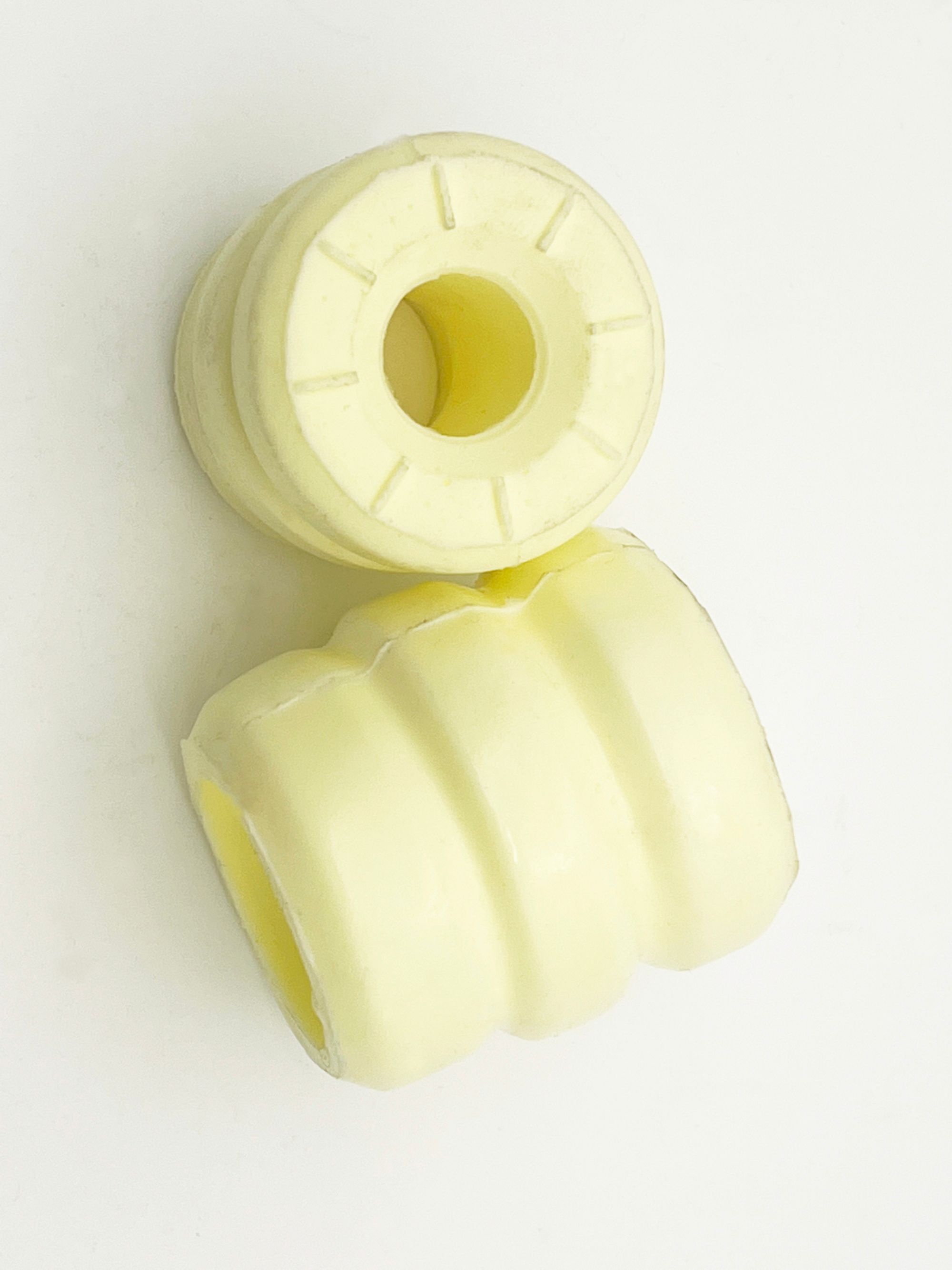
A jounce bumper's longevity starts with its material chemistry. Unlike many standard rubber parts that rely on natural or SBR rubber compounds, a well-designed jounce bumper is typically molded from microcellular polyurethane. That closed-cell foam structure allows the part to compress repeatedly without developing surface cracks or internal tearing. The cell walls distribute impact energy more evenly, so the material doesn't overheat or degrade as quickly as solid rubber under the same pounding.
Another factor is the operating profile. Standard rubber components such as bushings, isolators, or hoses often face constant flexing, oil exposure, and high ambient heat. A jounce bumper, by contrast, works mostly in short, high-energy bursts at the end of suspension travel. This intermittent duty cycle gives the polyurethane time to recover its shape and cool down between impacts. Combined with superior resistance to ozone, road salt, and moisture, that recovery window helps the bumper stay functional long after ordinary rubber pieces have hardened or crumbled.
How a Specialized Exporter Keeps Jounce Bumpers Ready for Rough Terrain
A jounce bumper isn't just a chunk of rubber bolted to the chassis. For a specialized exporter, it's a precision-tuned part that has to survive washboard gravel, deep ruts, and sudden axle drops without cracking, collapsing, or losing its progressive damping curve. The difference between a generic aftermarket copy and an export-grade unit often comes down to material compounding: we use microcellular polyurethane with a closed-cell structure that resists water absorption and heat buildup, so the bumper keeps its shape even after hours of hard compression in desert terrain.
Before anything ships, every production batch goes through a low-temperature impact test—minus forty degrees Celsius, then a full compression stroke. Most failures happen at the bond line between the metal cup and the elastomer, so we machine the cup with a knurled inner profile and apply a two-stage adhesive primer under controlled humidity. That process alone cuts warranty claims by a third compared to standard press-fit designs. For rough-terrain clients, we also offer a reinforced version with an internal nylon skeleton that prevents lateral blowout when the suspension bottoms out on sharp ledges.
Inventory readiness matters as much as the part itself. Instead of waiting for a container order, we keep common durometer ratings and vehicle-specific profiles on shelf in bonded warehouses near major ports. If a mining fleet in Chile or a forestry contractor in Canada needs replacement bumpers mid-season, we can have them packed and loaded within 48 hours. Each shipment includes batch traceability codes stamped on the bumper body, so if a unit ever does fail, the customer can pull the exact compounding and curing record without digging through paper files. That kind of transparency is what turns a one-off export order into a long-term rough-terrain supply contract.
What Happens Between Raw Material and Worldwide Delivery for Suspension Parts
A suspension part starts moving long before it looks like anything recognizable. Raw steel arrives as bar stock or coil, each heat tagged with its own chemical fingerprint. Forklift drivers stage it by alloy grade while the first machines shear or saw it into blanks. Forged control arms and knuckles take shape under massive dies that realign the metal's internal grain, giving the part more fatigue resistance than a simple cut-out ever could. Even at this stage, dimensional checks happen at the press, not just in a lab afterward.
From there, the blanks move through CNC machining centers where bores, threads, and mounting faces are cut to tolerances tighter than a human hair. Heat treatment follows—often induction hardening on high-wear surfaces—then a corrosion-protection layer like e-coat or zinc flake. It's easy to assume this is a smooth conveyor line, but reality is messier. Some parts get pulled aside for CMM inspection, some get reworked, and some batch samples go through salt spray testing to make sure the coating won't fail after a few winters. The floor supervisor's whiteboard usually carries more authority than the production schedule.
Once machining and finishing are done, bushings, ball joints, and boots are pressed or assembled, then the parts face functional tests—checking articulation torque, seal leakage, or load capacity depending on what the part is supposed to do. Batch traceability doesn't end at the factory gate: each pallet carries the melt number, heat treat lot, and coating date. Packaging uses VCI paper or rust-inhibiting film, and crates are routed through ocean or air freight depending on urgency. By the time a suspension component reaches a warehouse in another hemisphere, it has passed through at least a dozen hands, each one adding a measurable step to the part's history.
Why Heavy Duty Fleets Rely on One Exporter for Repeat Suspension Orders
For fleet managers running Class 8 trucks, downtime from a failed suspension isn't just an inconvenience—it's a revenue leak. That's why repeat orders go to the same exporter who understands that a leaf spring or torque rod isn't a commodity; it's a part that has to survive potholes, overloaded trailers, and thousands of highway miles. When a supplier proves they can ship parts that fit without modification and last beyond the warranty window, swapping vendors starts to feel like an unnecessary risk.
Heavy duty fleets don't buy suspension parts on a whim. They schedule replacements around PM cycles, seasonal demand, and driver availability. One exporter earns repeat orders by keeping a running inventory of the fleet's exact specs—bushing sizes, U-bolt lengths, hanger spacing—so when a purchase order comes in, the parts leave the dock pre-matched to the fleet's axles and load ratings. That kind of memory saves hours of back-and-forth emails and eliminates the "wrong part, wrong week" scenario that can park a truck for days.
There's also the matter of after-sale support. A good exporter doesn't disappear after the invoice clears. When a fleet runs into an unusual failure pattern—say, premature bushing wear on a specific route—that exporter digs into the data, suggests a different compound or a heavier clamp, and ships the revision without hiking the price. That consultative approach turns a transactional parts buyer into a loyal account, because the fleet isn't just buying suspension components; it's buying the confidence that the next order will show up right, on time, and ready to bolt on.
FAQ
The polyurethane compound stays flexible in freezing temperatures and doesn't soften in desert heat, so suspension performance stays consistent year-round.
They cover everything from passenger cars and SUVs to commercial trucks and off-road equipment. We can also recommend the right durometer for heavier axle loads.
Yes, we can mold your logo or part number directly into the bumper and package them under your brand with no minimum order on repeat runs.
We use a dual-stage curing process and add UV inhibitors, which keeps the material resilient after thousands of compression cycles.
We arrange sea freight, air freight, and express courier services depending on urgency. Most bulk orders leave our facility within two weeks.
Sure. We can send a small batch of standard sizes, or produce a pre-production sample with your exact specifications for approval.
They absorb the final stage of suspension travel gradually, so hard hits feel softer and the chassis doesn't bottom out harshly.
In most cases, yes. We follow OEM dimensional tolerances, but we can also supply custom retainers or adapters if your setup differs.
Conclusion
Most drivers never think about the small foam or rubber collar that sits between a vehicle’s frame and its shock absorber, yet that part—the jounce bumper—takes the brunt of every pothole strike, speed bump hit, and fully compressed suspension cycle. Without a properly engineered bumper, the shock absorber’s piston can slam into the cylinder body, causing internal damage, leaking seals, and eventual failure. A specialized exporter has built its reputation around supplying jounce bumpers made from closed-cell microcellular polyurethane and high-resilience elastomer blends that outperform conventional rubber by a wide margin. These materials resist compression set, ozone cracking, and abrasive wear, which means the bumpers keep their shape and energy-absorbing properties after years of hard use on gravel roads, construction sites, and poorly maintained highways. The exporter runs batches through cyclic load testing, salt spray exposure, and temperature swings from arctic cold to desert heat before any part gets approved for shipment.
From the raw polymer mixing stage to final inspection and container loading, the operation follows a tight sequence that eliminates variation. Injection molds are checked for flash and dimensional drift every shift, and each production lot receives a hardness and rebound verification. Because the exporter maintains warehousing partnerships near major ports in Asia, Europe, and North America, replacement bumpers reach distributors without the usual transcontinental delays. That logistical reliability matters most to heavy-duty fleet operators, who cannot afford to park a delivery truck or mining vehicle for a week waiting on a backordered suspension part. Over time, those fleets place repeat orders not because of a contract, but because the bumpers arrive predictably, fit without modification, and extend the service life of expensive shock absorbers. This quiet, behind-the-scenes consistency is what keeps the exporter’s suspension parts moving across borders month after month.
Contact Us
Contact Person: Leela
Email: [email protected]
Tel/WhatsApp: 8613586885132
Website: https://www.xiayishockparts.com