
Textured Vegetable Protein Production Line: The Ultimate Guide to Efficient Manufacturing
2026-08-08
In the fast-evolving world of plant-based foods, textured vegetable protein (TVP) has emerged as a game-changer. But behind every high-quality TVP product lies a meticulously designed production line. That’s where MINGDE steps in—redefining efficiency and reliability in manufacturing. Whether you're scaling up or fine-tuning your process, understanding the ins and outs of a modern TVP production line is your first step toward staying ahead. This guide unpacks the essential know-how, from raw material handling to final packaging, all through the lens of real-world, no-nonsense engineering.
TVP Production Line: From Mixing to Packaging
At the heart of the TVP production line, raw ingredients—typically defatted soy flour or concentrates—are precisely blended with water and, depending on the desired profile, starches or flavor precursors. The mixing system isn’t just a homogeneous turn; it’s tuned to manage moisture distribution and shear, setting the stage for the protein’s structural transformation. Operators often make real-time adjustments here, responding to subtle shifts in ingredient batches or ambient conditions—a practice that turns a recipe into a craft.
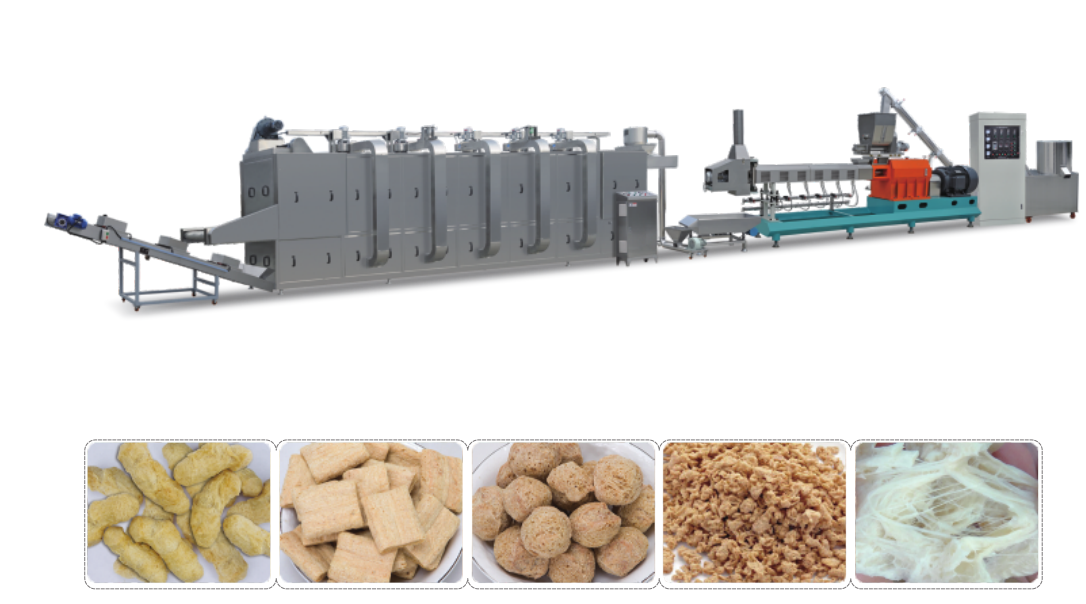
The mixture then enters a twin-screw extruder, where controlled heat and pressure unfold the protein chains. Far from a one-setting-fits-all approach, the screw configuration and barrel temperatures are dialed in to match the target texture—whether that’s a delicate shred mimicking slow-cooked meat or a firmer, chunkier bite. As the mass exits the die, the sudden pressure drop flashes off steam, giving the product its characteristic spongy, fibrous structure. The moment of expansion is where science meets instinct; an experienced eye can tell in seconds if the line is hitting the mark.
After extrusion, the still-warm product passes through a dryer that strips away enough moisture to ensure shelf stability without turning it brittle. From there, optional flavor infusion banks coat or spray on seasonings in a tumbling drum, where every piece gets its share. Packaging doesn’t just seal it up—vacuum or gas-flushed pouches, often with checkweighers and metal detectors in line, make sure what lands on the shelf is consistent and safe. It’s a seamless path from mixer to pallet, designed not only for speed but for the quiet confidence that each batch will perform precisely as promised in a kitchen or plant downstream.
Why Extrusion Parameters Can Make or Break Your Product
Dialing in the right extrusion parameters isn't just a technical checkbox—it's what separates a reliable, high-performance product from one riddled with defects. Temperature, for instance, doesn't just melt the material; it governs viscosity, flow uniformity, and even the molecular alignment that shapes strength and flexibility. A few degrees too low and you risk incomplete melting, leading to weak spots or surface imperfections. Too high, and the polymer can degrade, causing brittleness or discoloration that undermines both function and appearance. That tightrope walk demands constant attention, because every resin grade has its own sweet spot.
Screw speed and barrel pressure are equally critical, yet often overlooked as simple output levers. In reality, they control shear rate and residence time—the length of time the material spends under heat and mechanical stress. Push the screw too fast and you might generate excessive shear heat, inviting thermal breakdown before the melt even reaches the die. Too slow, and the residence time stretches, raising the risk of stagnation and charred particles contaminating the final profile. The interplay between these factors can subtly alter surface finish, dimensional stability, and even the way the product behaves in secondary operations like welding or coating.
Cooling and haul-off rates add another layer of complexity. Rapid, uneven cooling can lock in internal stresses that warp the part days or weeks after manufacturing, while inconsistent take-up speed can stretch or compress the extrudate, throwing tolerances out the window. These parameters aren't static either—they require real-time fine-tuning based on ambient conditions and upstream material variations. Ignoring them is like baking a cake without checking the oven's true temperature or cooling it on a tilted rack; you might get something that looks acceptable out of the line, only to see it fail miserably in the real world.
Equipment Investments Worth Upgrading
Sometimes the most impactful improvements come from giving your existing tools a second look. Rather than chasing the latest model, consider whether your current gear can be enhanced to match new demands. A lens with faster autofocus, a camera body with a sensor upgrade, or even swapping out worn tripod legs can breathe fresh life into your workflow. These tweaks often cost a fraction of a full replacement while delivering a noticeable leap in performance.
Audio equipment, lighting rigs, and support systems are prime candidates for incremental upgrades that frequently get overlooked. A new microphone capsule can refine your sound without the need for an entirely new setup, just as swapping your softboxes for a more efficient diffusion material changes the quality of light dramatically. Investing in better cables or power solutions might seem minor, but they prevent interruptions that eat into productive time, making the upgrade pay for itself quickly.
The key is to identify the single weakest link holding back your results and address it directly. It might be a monitor calibration tool that finally ensures prints match what you see on screen, or a faster memory card that keeps up with burst shooting. These focused investments often sharpen your competitive edge without the clutter of unnecessary gear, reinforcing the idea that smart refining beats constant replacing.
Small Tweaks That Improve Yield and Reduce Waste
Fine-tuning cutting speeds and feed rates can dramatically reduce material loss without compromising quality. By analyzing tool wear patterns and adjusting parameters in real time, manufacturers often find they can extend the life of consumables and achieve cleaner cuts, which means fewer rejected parts and less scrap heading to the bin.
Simple software updates to nesting algorithms help maximize the number of components that fit on a sheet, automatically arranging layouts to reduce unused space. This kind of digital tweak doesn't require new hardware but can lead to double-digit improvements in material utilization, paying for itself quickly through lower raw material costs.
Routine maintenance often gets overlooked, yet something as basic as calibrating sensors or sharpening blades can have a direct impact on yield. When machines run within precise tolerances, they produce consistent output, minimizing the random errors that generate waste. A maintenance log paired with staff training on spotting early warning signs turns small daily habits into significant long-term savings.
Scaling Up from Lab to Production Without Quality Loss
Moving from a controlled lab environment to full-scale production often feels like stepping into a different world. The precise, small-batch processes that worked perfectly on the bench can crumble under the weight of higher throughputs, different equipment dynamics, and the inherent variability of raw materials. Bridging this gap isn't just about buying bigger reactors or upgrading pumps—it's about deeply understanding the scale-dependent parameters that quietly govern product quality. Heat transfer rates shift, mixing times stretch, and reagent interactions morph in ways that render your optimized lab protocol almost irrelevant unless you've captured the fundamental engineering principles behind each step.
Preserving quality demands a deliberate focus on a handful of critical attributes that truly define your product's performance. Instead of chasing an exhaustive list of measurements, identify the few data signatures—perhaps a rheological fingerprint, a spectral peak ratio, or a crystallization onset temperature—that correlate directly with end-use success. By monitoring these in real time and pairing them with automated process adjustments, you create a feedback loop that compensates for scale-induced drift before it becomes a defect. This approach turns the process from a rigid recipe into an adaptive strategy, one that shrugs off external noise and maintains tight control over what matters, whether you're making grams or tons.
Finally, embrace the subtle art of designing for manufacturability early on, long before you think about production volumes. Small formulation tweaks—substituting a solvent with lower viscosity, altering an addition sequence to mitigate exotherms—can strip out hidden scale-up risks without sacrificing the core value of the product. When you embed these considerations into the development phase, you're not just transferring a process; you're evolving it into something inherently robust. The result is a seamless journey from lab curiosity to market reality, where quality isn't a fragile achievement but a built-in trait of the scaled operation.
The Role of Automation in Modern TVP Manufacturing
TVP production once hinged on manual oversight at nearly every turn—from adjusting ingredient ratios to monitoring texture changes in real time. Automation has shifted this landscape, introducing precision-driven systems that maintain consistency without constant human intervention. In modern facilities, smart sensors and control loops now manage temperature, viscosity, and blending speeds, directly reducing batch-to-batch variation. The result is a streamlined process where line operators focus on exception handling rather than minute-by-minute adjustments, leading to tighter tolerances and fewer delayed runs.
Beyond basic control, data integration has become the true differentiator. Production lines equipped with connected devices capture granular data on factors like emulsification stability and protein denaturation rates. This information flows into analytics platforms that flag subtle deviations long before they impact final quality. Manufacturers can then recalibrate parameters proactively—tweaking shear rates during mixing or adjusting cooking times based on real-time feedback—without waiting for lab results. The shift from reactive troubleshooting to predictive management saves hours of downtime and drastically cuts waste, particularly when switching between recipes with differing viscosity profiles.
On the operational side, automated cleaning and changeover protocols have redefined what flexible manufacturing looks like. Instead of lengthy manual washdowns between product runs, closed-loop CIP systems now execute pre-programmed cycles that verify cleanliness through conductivity sensors. This not only accelerates turnaround but also reduces water and chemical usage—a growing concern in many regions. Meanwhile, robotics in packaging and palletizing are eliminating repetitive strain injuries while ensuring exact portioning and seal integrity. The quiet evolution here is that automation no longer just replicates human actions; it creates patterns of work that were previously impossible, unlocking higher throughput without expanding floor space.
FAQ
A textured vegetable protein production line is a series of integrated machines that convert plant-based proteins, such as soy or pea, into fibrous, meat-like textures. It typically involves mixing, cooking, extrusion, cutting, and drying steps. Raw materials are hydrated and fed into an extruder where heat and pressure restructure the protein, creating a chewy, layered product.
Key equipment includes a preconditioner for pre-hydration, a twin-screw extruder for consistent cooking and texturization, a rotary cutter for shaping, a multi-layer belt dryer for moisture control, and a cooling conveyor. Auxiliary systems like dosing feeders and control panels are also critical for seamless operation.
Optimizing screw configuration and die design in the extruder can increase throughput while maintaining texture. Precise control of moisture, temperature, and feed rate ensures uniform product. Regular calibration of sensors and automation of changeover processes reduce downtime, boosting overall efficiency.
Temperature profiles inside the extruder barrel directly affect protein denaturation and texture formation. Gradual heating zones ensure proper melting and alignment of proteins, while cooling zones at the die set the final structure. Inconsistent temperatures can lead to poor expansion or off-flavors.
Protein isolates or concentrates with high solubility and low fat content yield better texture and rehydration properties. Impurities or inconsistent particle sizes can cause blockages and uneven processing. Selecting functional ingredients also influences the bite and mouthfeel of the final product.
Regular inspection of screws, barrels, and die plates for wear prevents unexpected breakdowns. Lubricating bearings, cleaning filters, and checking alignment of cutting blades extend equipment life. Implementing a predictive maintenance schedule based on runtime hours minimizes unplanned stops.
Automated systems monitor and adjust parameters in real-time, reducing human error and ensuring batch consistency. Data logging enables traceability and rapid recipe switching. Integration with upstream and downstream equipment streamlines material flow, cutting labor costs and waste.
TVP uses fewer natural resources, generating a lower carbon footprint per kilogram of protein. Its shelf stability and high reconstitution ratio reduce transportation and storage costs. For processors, it offers versatile ingredient options without the variability of animal supply chains.
Conclusion
Manufacturing textured vegetable protein at scale is a delicate balance between science and engineering. The line starts with precise mixing of raw ingredients—proteins, water, and additives—to form a uniform dough, but the real magic happens in the extruder. Controlling parameters like screw speed, temperature, and pressure isn’t just technical detail; it dictates whether your final product has the right texture and hydration properties. Investing in high-quality, twin-screw extrusion systems with modular barrels can drastically improve consistency and throughput. At the same time, even modest upgrades, such as improved die designs or better filtration, can reduce waste by several percentage points without breaking the bank.
Scaling from bench-top trials to full production often unveils hidden challenges, particularly in maintaining product identity. Here, automation proves invaluable—real-time monitoring of moisture and density can compensate for scale-induced variability. Simple tweaks like optimizing cutter speeds and adjusting drying profiles often unlock higher yields. Ultimately, an efficient TVP line isn’t just about hardware; it’s about integrating smart sensors and feedback loops that let operators intervene before deviations become defects. This guide underscores that every stage, from mixing to final packaging, offers opportunities for incremental gains that compound into significant cost savings and superior product quality.
Contact Us
Contact Person: LILY SUN
Email: [email protected]
Tel/WhatsApp: 0086-13969103791
Website: https://www.snackfoodmachinery.com/