Top Hot-Dip Galvanized Channel Steel Factory Delivers Durable Structural Solutions
2026-09-06
When corrosion quietly eats away at structural integrity, the difference between a lasting build and a costly failure often comes down to one decision: the steel channel beneath the surface. At Shunchen steel, a top hot-dip galvanized channel steel factory, that decision gets easier. Their galvanizing process fuses zinc to steel in a way that shrugs off moisture, chemicals, and time — delivering durable structural solutions for projects that can't afford shortcuts. But what really sets their channels apart? It's not just the coating; it's the precision behind it. Read on to see how the right factory turns raw steel into a backbone you can trust.
What makes the galvanized layer so resistant to flaking
The galvanized layer's resistance to flaking is rooted in the metallurgical bond that forms during hot-dip galvanizing. When clean steel is immersed in molten zinc, a series of iron-zinc alloy layers grow from the steel surface, creating a tightly interlocked structure rather than a simple mechanical coating. This diffusion-driven process means the outermost pure zinc layer is chemically anchored to the steel through intermediate phases like gamma, delta, and zeta, each with distinct crystal habits that help distribute stress more evenly than a sprayed or painted film ever could.
Unlike coatings that rely on surface adhesion alone, galvanizing produces a gradient of hardness and composition from the steel inward. The innermost alloy layer is actually harder than the base steel, which prevents cracks from initiating at the interface. Even under impact or flexural loading, the layered microstructure lets tiny deformations dissipate through ductile zinc phases instead of concentrating at one weak boundary. This is why galvanized parts can be formed, punched, or even bent after coating without the layer cracking off in sheets.
Environmental exposure also plays a role, but not in the way many expect. As the outer zinc corrodes sacrificially, it forms a dense, adherent patina of zinc carbonate that further stabilizes the surface. The alloy layers beneath remain intact because corrosion products fill micro-crevices rather than wedging them apart, and the sheer thickness of the intermetallic zones—often exceeding the pure zinc overlay—provides a substantial buffer against flaking. Over decades, the coating may slowly wear away, but it does so by uniform thinning, not by delamination from the steel.
The load-bearing design behind each channel profile
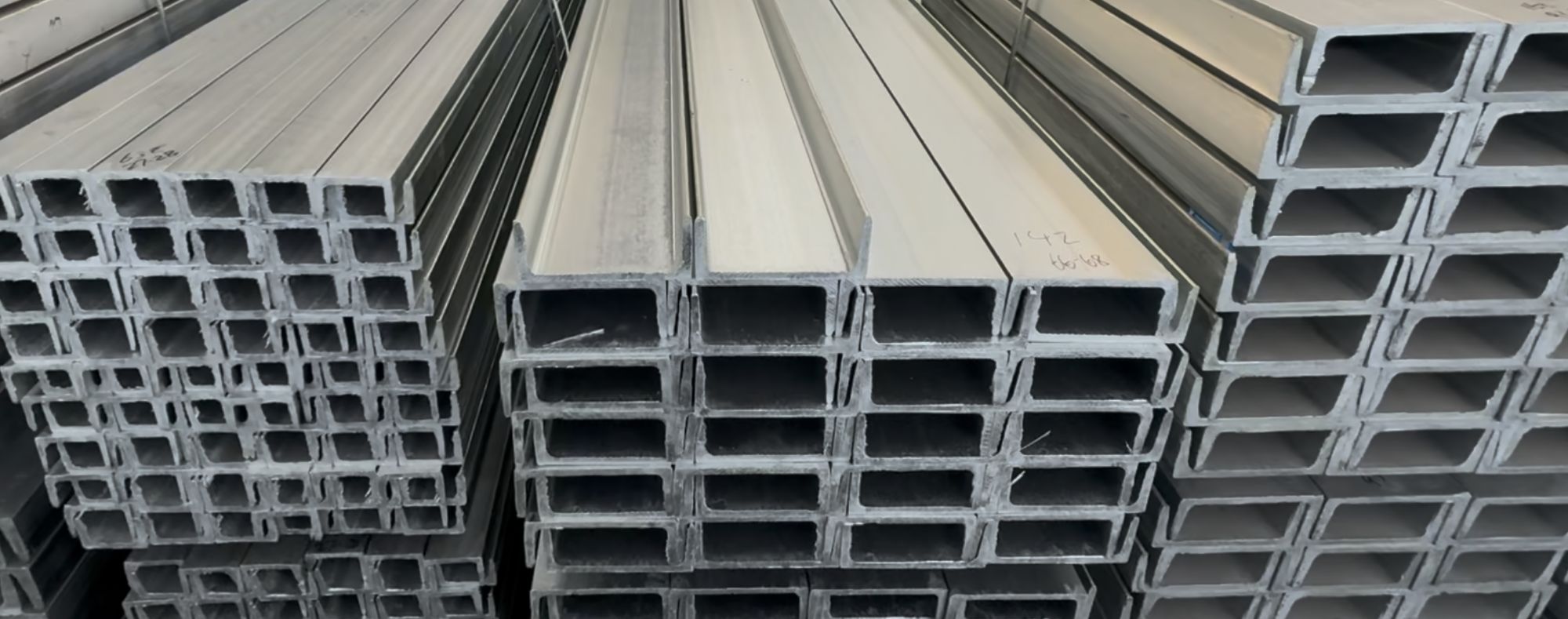
The load-bearing role of a channel profile starts with its cross-section, not with the material itself. A deeper web increases bending stiffness, but only when the flange width and wall thickness stay in proportion. If the flanges are too wide or too thin, the free edges buckle early and much of the section becomes ineffective under load. That balance between web depth, flange width, and wall thickness determines how much load the profile can carry before deflection becomes a problem.
Beyond the basic geometry, the load path is shaped by small details that are easy to overlook. Tapered corners between the web and flanges spread stress instead of letting it concentrate at a sharp angle. Internal ribs and local thickening are placed where shear forces peak, so the profile resists bending and torsional loads without carrying unnecessary weight. These reinforcements matter most in frames and supports that are assembled with bolts or brackets, because the connection points often see higher local stress than the rest of the span.
Real-world performance also depends on how consistently the profile can be manufactured. Slight changes in wall thickness or corner radius shift the neutral axis and alter the deflection behaviour. A well-designed channel profile accounts for that variation by keeping the critical load path away from the weakest section and by validating prototypes under repeated load tests. This way the profile bends or yields in a controlled way at a known overload, rather than failing suddenly at an unexpected point.
Hot-dip galvanizing vs. paint and powder in the field
Field crews often notice the difference halfway through installation. Hot-dip galvanizing comes ready from the kettle with a complete, metallurgically bonded zinc-iron alloy layer that shrugs off the scrapes and bumps of a job site. Paint and powder coatings, on the other hand, arrive with a thin polymer skin that can chip, scratch, or peel the moment a wrench slips or a beam drags across a trailer bed. Those small breaches aren't just cosmetic; they expose raw steel to moisture, and rust spreads underneath the surrounding film before anyone spots it.
Another practical gap shows up in touch-up work. When galvanized steel gets gouged in the field, the surrounding zinc sacrifices itself to protect the exposed area — a quick cold-galvanizing spray is usually enough for minor damage. Paint and powder don't offer that kind of cathodic back-up. A scratched powder-coated railing or a nicked painted bracket often needs sanding, priming, and recoating, and if the original finish has aged or faded, matching the color becomes a guessing game. That's why many site supervisors treat powder-coated parts as fragile inventory while galvanized parts go straight to the laydown yard.
Durability in real weather also separates them. After a few seasons of sun, rain, and freeze-thaw cycles, powder coatings can chalk, fade, or lose adhesion at edges, while paint tends to crack at bolted connections where movement occurs. Hot-dip galvanizing weathers slowly and uniformly, developing a stable patina rather than flaking away. For structures that are hard to access later — transmission towers, bridge components, or rooftop supports — that field performance difference makes galvanizing the default choice for many engineers, even when the initial coating cost is higher.
Inside the production line where bonding quality is set
Along the line, a series of roller presses apply exact pressure to each joint while a thermal camera records the heat signature. Operators adjust the dwell time based on real-time feedback, not a printed spec sheet.
Quality is set the moment the adhesive bead width falls within a ten-micron tolerance. A laser micrometer sweeps every bond twice, and any deviation triggers a soft stop that lets the cell be reworked before curing starts.
At the final station, a peel test on a sacrificial sample confirms the crosslink strength. The reading is logged against the batch number, creating a traceable record that follows the part downstream.
Custom sizing and hole punching without delaying delivery
Getting exact dimensions and precise hole placement usually means waiting extra days—or paying a premium. Our workflow handles both custom sizing and hole punching in parallel with standard production runs, so your order ships on the same schedule as off-the-shelf parts. No separate quoting step, no hand-offs between teams.
Every panel is cut from sheet stock to your specified width and length, then moved directly to a dedicated punching station. Hole patterns, edge distances, and slot shapes are verified against your drawing before the part leaves the floor. We keep a library of common punch tooling on hand, which eliminates the lead time that typically comes with custom die fabrication.
What this means in practice: you can order 47 pieces with a 3.2 mm offset hole pattern this morning and have them in transit by tomorrow afternoon. The sizing and punching don't add a separate queue—they become part of the same production flow we use for high-volume blanks.
Built for coastal, industrial, and buried applications
Salt-laden air, constant dampness, and abrasive soil don’t leave much room for compromise. This line holds up in all three environments because the jacketing and sealing methods were chosen for long-term exposure rather than just occasional weather resistance. Coastal installations get a tough outer skin that shrugs off corrosion and UV breakdown, while buried runs benefit from a moisture-blocking construction that won’t wick water or crack under soil pressure.
On the industrial side, the same build handles vibration, oil mist, and temperature swings without turning brittle or losing its seal. Conductor insulation and shielding remain stable when equipment runs hot or when footing is uneven, so you spend less time chasing intermittent faults. It’s the kind of ruggedness that makes sense once you’ve had to replace cheaper cable after a single season near the water or under a loading dock.
The result is a single product family you can spec across a port, a processing plant, or a direct-burial feeder run instead of juggling three different constructions. That reduces inventory and keeps installation practices consistent, especially for crews who move between marine, factory, and underground work. If the environment is harsh enough to ruin standard cable in a year or two, this is built to keep working well past that point.
FAQ
The zinc coating bonds metallurgically with the steel, so it resists scratches and impacts that would expose bare metal. That toughness, combined with the channel's inherent load-bearing shape, gives engineers confidence in both strength and longevity.
Immersion in molten zinc creates a barrier that blocks moisture and oxygen from reaching the steel underneath. Even if the surface is nicked, the surrounding zinc corrodes first and protects the exposed area, a behavior known as cathodic protection.
You will find them in solar panel support frames, highway guardrails, agricultural buildings, transmission towers, and marine walkways. Essentially anywhere steel faces weather or chemical exposure, galvanized channels are a common sight.
Yes, custom dimensions are available, including non-standard web heights, flange widths, and cut-to-length sections. The factory works from detailed drawings to ensure each piece fits the intended design without requiring field modifications.
Each batch undergoes visual inspection for coating uniformity, thickness measurements with magnetic gauges, and bend tests on sample pieces. Documentation such as mill test reports and galvanizing certificates can be supplied on request.
Heavier coatings, usually specified in microns, extend service life in coastal or industrial atmospheres where salt and chemicals accelerate corrosion. For most structural applications, a minimum average coating of 70 to 85 microns is recommended, with thicker layers available for extreme conditions.
Yes, the channel's orientation matters. A C-channel resists bending best when loaded along its web, while twisting can occur if forces hit the open side. Engineers often pair channels back-to-back or add stiffeners to control deflection in heavy applications.
Standard stock sizes can ship within a week or two, but custom fabrication and galvanizing typically add two to four weeks depending on order volume and current production schedule. Early communication about deadlines helps the factory sequence jobs efficiently.
Conclusion
At the core of every structural profile leaving this hot-dip galvanized channel steel factory is a bond that refuses to let go. The zinc layer doesn't simply coat the surface; it metallurgically fuses with the steel during immersion, forming intermetallic alloys that resist flaking even under heavy impact or bending. Each channel is engineered with load-bearing flanges and web thicknesses calculated for real site conditions, not just catalog specs. Whether you need custom lengths, slotted holes, or off-center punching, the production line adjusts quickly without pushing delivery dates. From the moment raw coil enters the line, automated pre-treatment and controlled bath temperatures set the quality of adhesion, ensuring every piece exits with a uniform, abrasion-resistant layer.
Field performance tells the sharper story. Hot-dip galvanizing outperforms paint and powder coating where it matters most: at cut edges, scratched surfaces, and threaded connections, the zinc sacrificially protects exposed steel for decades. Coastal salt spray, industrial fallout, and direct burial in aggressive soils are everyday environments for these channels, yet the coating remains intact long after conventional finishes have peeled or rusted through. The factory's in-house sizing and punching capabilities mean structural engineers don't have to compromise on design to meet a schedule. Instead of waiting for secondary processing, each order arrives ready for immediate installation, reducing crane time and on-site labor. By combining metallurgical bonding with flexible manufacturing, this facility delivers channel steel that stands up to punishment without standing still on the production floor.
Contact Us
Contact Person: Max Zhou
Email: [email protected]
Tel/WhatsApp: +86 15712216177
Website: https://www.shunchensteelmaterial.com/