Zinc-Nickel Alloy Plating Equipment Exporter: Advanced Plating Systems for Corrosion-Resistant Industrial Finishes
2026-09-01
Industrial finishing demands more than a shiny surface—it demands durability. Zinc-nickel alloy plating has become the go-to defense against corrosion in automotive, aerospace, and heavy equipment. Yet the results depend heavily on the equipment behind the bath. That’s where Junda stands out. As a specialized exporter of advanced zinc-nickel alloy plating systems, Junda delivers the precision and reliability needed for long-lasting, corrosion-resistant finishes. Here’s a closer look at what makes their approach different.
Why Zinc-Nickel Plating Outlasts Conventional Zinc Finishes
Zinc-nickel plating isn't just a marginal upgrade over standard zinc—it's a fundamentally different animal. Conventional zinc coatings sacrifice themselves to protect the base metal, and once that sacrificial layer wears away, corrosion sets in fast. Zinc-nickel, typically alloyed with 12-15% nickel, forms a denser, harder deposit that resists both red rust and white corrosion far longer. The nickel content alters the electrochemical potential, slowing the corrosion rate even after the coating is breached. That means parts survive salt spray tests, thermal cycling, and real-world road grime without the rapid pitting and flaking you'd see from plain zinc.
Durability also comes down to microstructure and stress. Pure zinc deposits tend to be columnar and porous, offering pathways for moisture and chlorides. Zinc-nickel plates with a finer, more equiaxed grain structure, especially when paired with the right passivation and topcoat. This tighter lattice doesn't just block corrosion—it withstands mechanical wear from fasteners, vibration, and assembly torque far better. In automotive applications, where connectors and brake components face both saline spray and constant movement, zinc-nickel consistently outlasts conventional zinc by a factor of three to five before any base metal exposure appears.
Finally, let's talk about compatibility and hydrogen embrittlement. High-strength steel parts plated with standard zinc often require lengthy baking cycles to drive out hydrogen, and even then failures occur. Zinc-nickel's alloyed structure reduces hydrogen absorption during plating and offers better adhesion under stress. Combined with hexavalent-free passivations that maintain corrosion resistance above 720 hours in neutral salt spray, it's no contest. For anyone who's seen a galvanized bracket rust through in two winters while the rest of the assembly remains sound, switching to zinc-nickel isn't a luxury—it's the only finish that makes engineering sense.
A Walk Through Our High-Efficiency Plating Line Design
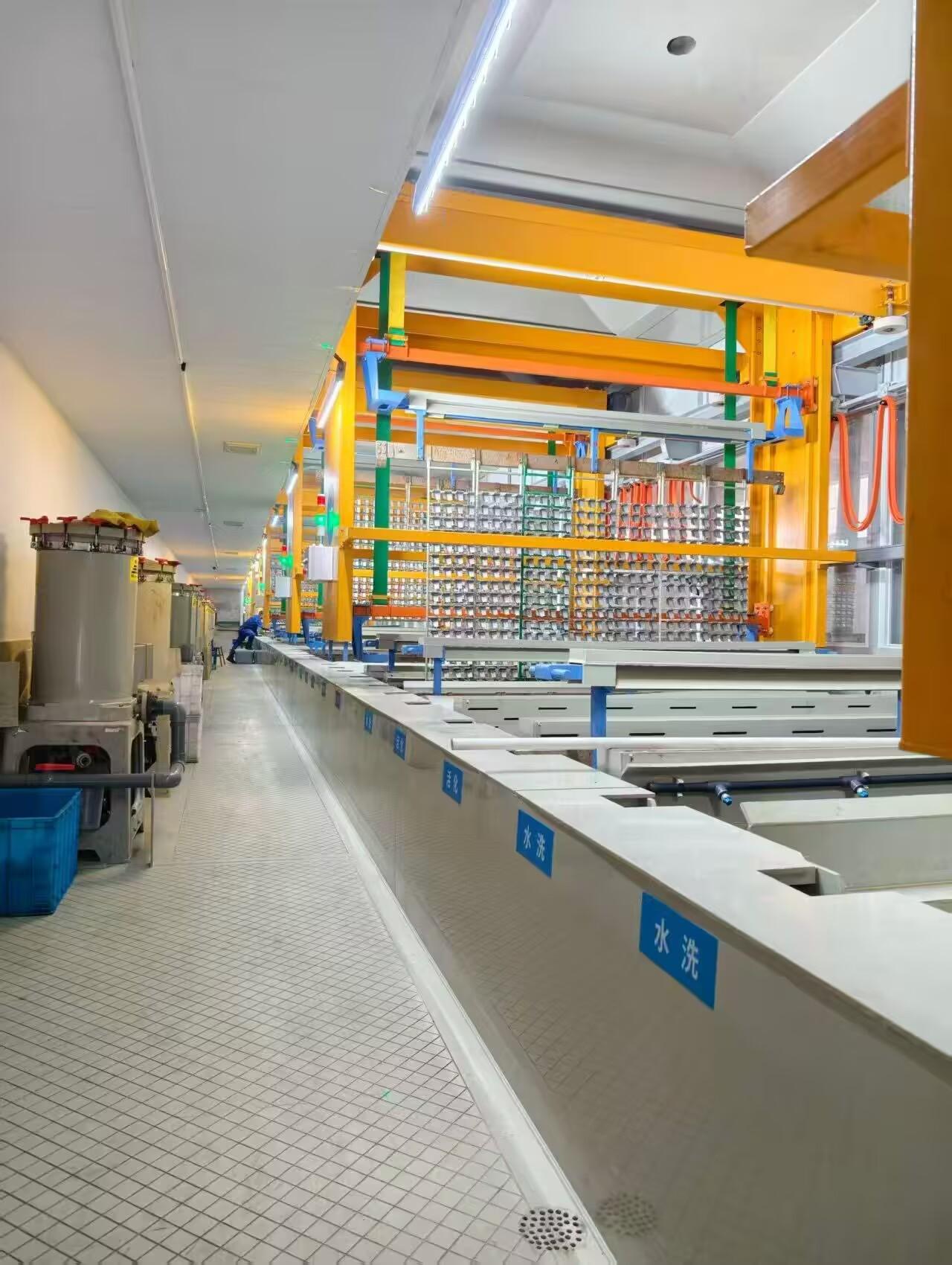
Stepping onto the floor of our high-efficiency plating line, the first thing you notice is the linear flow—no backtracking, no cross-contamination. Tanks are arranged in a single U-shaped loop with dedicated load/unload zones at each end, which keeps work-in-progress moving at a steady 12 racks per hour without bottlenecks.
The hoist system runs on a closed-loop servo drive rather than traditional chain lifts, allowing us to program variable dwell times for each bath. That flexibility means the same line can switch from zinc-nickel to tin plating in under 40 minutes. Rectifiers are mounted overhead, away from chemical splash zones, and each tank has an independent current control tied to a real-time thickness monitor.
Air handling is designed around push-pull ventilation over the process tanks, which cuts exhaust volume by a third compared to canopy hoods while keeping operator exposure well below PEL. Wastewater from rinses flows into a three-stage countercurrent recovery system, returning nearly 85% of the drag-out solution to the plating bath. It’s not just efficient on paper—every section of the line was laid out so that maintenance crews can access pumps, filters, and anodes without shutting down adjacent cells.
Tailored Equipment for Automotive and Aerospace Specifications
Every bracket, mount, and fixture gets built around a specific set of dimensional and material demands. For automotive work, that often means contending with tight engine bay clearances, heat cycling, and vibration. Aerospace adds its own layer: nickel alloys, titanium, and the paperwork trail tied to traceable raw stock. The shop floor treats a control arm jig with the same seriousness as a fuselage assembly aid, because both fail the same way when a millimeter drifts or a heat treat spec gets skipped.
What separates useful tooling from expensive scrap is how early the conversation starts. Drawings get reviewed for realistic tolerances, not just nominal geometry. Surface finishes, plating, and post-weld stress relief are factored in before the first cut. This keeps parts from being over-engineered in one area and under-supported in another, which is exactly where most one-size-fits-all equipment falls apart.
Meeting 1,000-Hour Neutral Salt Spray Requirements
Achieving 1,000 hours of neutral salt spray resistance is rarely about a single magic coating. It demands a system-level view where substrate preparation, primer adhesion, and topcoat integrity work in concert. Even small defects like micro-porosity or edge thinning become failure points once the fog settles in, so process control matters as much as chemistry.
In practice, the path to passing this benchmark often involves refining surface profile rather than simply adding more layers. A uniform grit-blasted anchor pattern, followed by a zinc-rich primer and a tightly cross-linked polyurethane or epoxy topcoat, can create the sacrificial and barrier protections needed. However, cure time and ambient conditions during application heavily influence the final result, and short-cutting these steps typically shows up as underfilm corrosion long before the 1,000-hour mark.
Validation is not just about reaching the hour count. Repeated testing across different batches, edge configurations, and scribed areas reveals whether a system can consistently hold up. When a product survives the full cycle without blisters or creep beyond the scribe line, it signals a robust defense against coastal or deicing salt exposure rather than a lucky pass.
Export-Ready Packaging Plus On-Site Commissioning
Every shipment leaves our facility in a purpose-built export crate, not a generic pallet wrap. We seal electronics against humidity with vacuum-packed barrier films, brace rotating assemblies with custom-cut foam, and mark the crate's center of gravity so your freight forwarder doesn't guess. Labels, documents, and lifting points are pre-checked against destination-country import rules before the door closes.
Once the crate arrives, our commissioning engineer travels to your site—not just to flip a switch, but to align, calibrate, and run the machine through its full cycle under real load. They stay until your operators can run the first production batch without hand-holding, and they leave behind a one-page startup log instead of a thick binder of generic checklists.
Real-Time Bath Monitoring for Consistent Alloy Deposition
In alloy plating, even minor shifts in bath chemistry can change the deposit's composition and performance. Real-time monitoring replaces infrequent manual sampling with continuous measurement of metal ion concentrations, pH, temperature, and additive levels. Sensors placed directly in the plating tank send data to a control unit every few seconds, so operators see drift as it happens rather than after parts are out of spec.
The immediate feedback allows automatic or manual adjustments before the bath strays outside its working window. For instance, when the ratio of nickel to iron begins to creep upward, dosing pumps can add the appropriate metal salt or a current controller can modulate the waveform to shift deposition rates. This keeps the alloy ratio within a narrow band across the entire run, reducing the need for rework or scrap.
For multi-component alloys with competing reduction potentials, real-time data is particularly valuable. It enables dynamic tuning of parameters such as pulse frequency, agitation, or brightener concentration based on actual bath conditions rather than fixed recipes. The result is more consistent thickness and composition from part to part, even in high-volume production where bath ageing and drag-out constantly alter the chemistry.
FAQ
Zinc-nickel deposits typically contain 12–15% nickel, which delivers significantly higher corrosion resistance—often lasting several hundred hours in salt spray testing without red rust. The alloy also holds up better at elevated temperatures and provides a harder, more wear-resistant surface than conventional zinc alone.
Automotive and heavy equipment manufacturers are the biggest users, especially for brake components, fasteners, and underbody parts. We also supply systems for aerospace, wind energy, marine hardware, and electrical enclosures where long-term exposure to moisture and road salts is a concern.
We assess part geometry, throughput targets, floor space, and required coating specifications first. Then we configure rack or barrel lines, rectifier capacity, tank sizing, and automation level accordingly. This means a job shop and a high-volume tier-one supplier get very different system layouts rather than a one-size-fits-all package.
Beyond shipping the equipment, we send engineers for on-site supervision, alignment, and commissioning. We also run pilot plating trials with the customer's own parts, train operators on bath control and maintenance, and stay available remotely for troubleshooting after production begins.
Yes. We use optimized anode arrangements, solution agitation, and programmable rectifiers to improve throwing power and deposit uniformity. This is essential for threaded fasteners, deep recesses, and parts with tight dimensional tolerances where uneven plating can cause assembly problems.
The line includes automated dosing for nickel and zinc additives, temperature control, and continuous filtration. We also integrate analytical tools or sampling routines so operators can monitor nickel percentage and adjust brightener levels with minimal manual guesswork.
Enclosed tanks, fume extraction, spill containment, and rinsing systems that reduce water use are standard in our layouts. We can also add wastewater treatment modules for closed-loop or near-zero discharge operation, depending on local regulations and the customer's sustainability goals.
Conclusion
Our company exports turnkey zinc-nickel alloy plating systems built for industrial finishers who need real corrosion protection, not just a thicker zinc layer. The difference shows up quickly in the field: conventional zinc coatings sacrifice themselves until rust breaks through, while a properly deposited zinc-nickel layer forms a dense, passivating film that keeps working long after standard zinc has failed. Our plating line design reflects that priority. We use high-efficiency rectifiers, automated hoist transfers, and counterflow rinsing to squeeze more parts per hour without losing deposit uniformity. For automotive and aerospace suppliers, we tailor fixtures, tank dimensions, and process documentation to match OEM specifications, whether the requirement is for brake calipers or landing gear components.
The equipment is validated to meet 1,000-hour neutral salt spray testing, which demands strict control over nickel content, temperature, and agitation. Instead of asking operators to guess, our systems include real-time bath monitoring that samples the electrolyte and adjusts dosing automatically, so the alloy ratio stays within a narrow band through long production runs. Once the line passes factory acceptance testing, we pack every module in export-grade crating and send a commissioning crew to the customer site for installation, calibration, and operator training. That gets the line running faster and avoids the usual finger-pointing between equipment makers and chemical suppliers. The end result is a plating operation that produces corrosion-resistant finishes with fewer rejects and less downtime.
Contact Us
Contact Person: hayyr
Email: [email protected]
Tel/WhatsApp: 8613082110525
Website: https://www.jundaelectroplating.com